Today's
EarthStation1.com 15% (Or More!) Off Commemorative Memorial Title:
Monsters! Mysteries Or Myths? + Bonus Yeti Doc MP4 Video Download
DVD
Today, August 7, 2026
August 7: National Sea Serpent Day: --
Commemorates of one of the most common sea serpent sightings. Sea
serpents, also known as sea dragons, were prevalent in ancient
myths and are commemorated on Sea Serpent Day. They were possibly
inspired, in part, by the enormous oarfish, which may grow to be
50 feet long and are rarely seen because they dwell thousands of
feet below the ocean's surface. National Sea Serpent Day remembers
sightings of sea serpents as well as the many other stories that
have been told about them. Serpents are typically portrayed as
dangerous monsters, as opposed to their so-called predecessor, the
innocuous oarfish. During their voyage to Saint Helena in the
South Atlantic in August 1848, men and officers aboard the HMS
Daedalus reported witnessing a 60-foot-long creature poking its
maned head and torso out of the water. One can only imagine the
awe and wonder they must have felt upon sighting such a creature.
Other stories have emerged over the years of equally incredible
sightings. Each story, unsurprisingly, presents different facts
that often dispute other accounts. The stories, however, continue
to spread. A sea serpent is a mythological and legendary aquatic
beast that resembles a gigantic snake. The belief in enormous sea
animals was common across the ancient world. Large water species
such as whales, sharks, and sea lions have, in many cases, been
mistaken for sea serpents. Cryptozoologists, on the other hand,
believe that sea serpents are relict plesiosaurs, mosasaurs, or
other Mesozoic marine reptiles. Serpent sightings are the stuff of
folklore. We may call them marine sirens. Cetus is the name given
to the sea creature in Greek mythology. The Kraken was mentioned
by the Vikings. Even we land-locked New World beings have names
for the serpents that reside in the watery depths of our major
lakes and waterways. On Sale Until Midnight Tonight PT!
https://store.earthstation1.com/monsters-mysteries-or-myths-dvd-loch-ness-monster-yeti-bigfoot.html
Today's
EarthStation1.com 15% (Or More!) Off Commemorative Memorial Title:
Lighthouses: Guardians Of The Night From Ancient To Modern Times
Today, August 7, 2026
August 7: National Lighthouse Day: -- On
this day in 1789, Congress approved an Act for the establishment
and support of lighthouse, beacons, buoys and public piers. In
celebration of the 200th anniversary of the signing of the act and
the commissioning of the first federal lighthouse, Congress passed
a resolution which designated August 7, 1989 as National
Lighthouse Day. Senator John H. Chafee (R., Rhode Island)
sponsored a joint resolution that was introduced to Congress on
April 28, 1988 to designated August 7, 1989 as National Lighthouse
Day. Though National Lighthouse Day is celebrated annually by
lighthouse organizations nationwide, Congress has yet to designate
August 7 as the date our country officially recognizes in
perpetuity the importance of America's lighthouse heritage.
Despite this, even without official recognition from Congress, the
nationwide lighthouse community continues to "keep the flame"
of America's rich lighthouse heritage burning bright. Each year,
August 7 is celebrated as National Lighthouse Day, with lighthouse
groups offering the general public a host of fun-learning
activities to enjoy - including tours, cruises and presentations
that pay special tribute to America's lighthouses and their grand
history. A lighthouse is a tower, building, or another type of
structure designed to emit light from a system of lamps and lenses
and to serve as a navigational aid for maritime pilots at sea or
on inland waterways. Lighthouses mark dangerous coastlines,
hazardous shoals, reefs, rocks, and safe entries to harbors; they
also assist in aerial navigation. Once widely used, the number of
operational lighthouses has declined due to the expense of
maintenance and has become uneconomical since the advent of
cheaper and often much more effective electronic navigational
systems. On Sale Until Midnight Tonight PT!
https://store.earthstation1.com/lighthouse-guardians-of-the-night-from-ancient-to-modern-times.html
Today's
EarthStation1.com 15% (Or More!) Off Commemorative Memorial Title:
Greek Fire: Ancient Greece In Today's World TV Series DVD, MP4,
USB
Today, August 7, 2026
August 7: Professional Speakers Day: --
This day is an occasion to celebrate all the people who stand up
in front of an audience. These people talk about different topics
to inform, educate, persuade and encourage people to take action
about the things that matter to them. Professional speakers have
an enormous impact on the lives of the people who listen to them.
Teaching, persuasion, or entertainment - no matter what the goal
of the speakers, they all influence the people who hear them talk.
Professional speakers engage in public speaking, which is also
known as oration. They speak to different kinds of audiences,
either live on stage or through pre-recorded. Professional
speakers have different goals for their speeches. They might want
to inform people about something, persuade people to do something,
or entertain people by talking about something interesting. The
best public speakers in the world always have an impact on their
audiences. People listen to speeches to learn something new or to
look for ways to transform their own lives. Public speaking as a
field developed in Greece and Rome, where it was an important part
of rhetoric - the art of persuasion. Demosthenes, a famous
professional speaker, delivered his first political piece of
oration in 354 B.C.; taught by Plato, one of Ancient Greece's best
professional speaking teachers, Aristotle recorded the rules of
professional speaking in his work, "Rhetoric" in 350
B.C.; and in 150 B.C., after they take over Greece, the Romans
adopt and further develop the curriculum for public speaking.
Today, public speakers are not only looking to persuade their
audiences but also educate them or entertain them. Regardless of
the type of speech, all speakers aim to get their audiences to act
in some way, either by incorporating the knowledge they have
gained or taking some action based on what they have learned. In
the history of professional speakers, there is some evidence of
speeches being made in Egypt, but the first records of the rules
and principles of public speaking used by professional speakers
are from Ancient Greece. In a culture where the people had to
speak for themselves rather than through advocates, every citizen
needed to learn the rules and methods of speaking professionally.
When the Romans took over, they adopted the Greek system of
teaching students public speaking and it was developed into a full
curriculum. They added training in grammar, warm-up exercises, and
declamation. On Sale Until Midnight Tonight PT!
https://store.earthstation1.com/greek-fire-ancient-greece-in-the-modern-era-tv-documentary-series.html
Today's
EarthStation1.com 15% (Or More!) Off Commemorative Memorial Title:
Meet George Washington: The Man Behind Myth + Bonus MP4 Download
DVD
Today, August 7, 2026
August 7, 1782: National Purple Heart
Day: -- George Washington orders the creation of the Badge Of
Military Merit, the oldest American military decoration for
military merit still awarded to this day, to honor soldiers
wounded in battle. Washington intended the honor to be presented
to soldiers for "any singularly meritorious action." The
Badge of Military Merit replaced the Fidelity Medallion, the
oldest decoration of the United States military. During the
American Revolutionary War, the Badge for Military Merit decorated
six known soldiers, William Brown and Elijah Churchill received
the first such honors. Its design included a purple, heart-shaped
piece of silk bound with a thin edge of silver. Across the face,
the word Merit was embroidered in silver. While the badge
symbolized the courage and devotion of an American Patriot, no one
knows who designed the award. Until Washington's February 22, 1932
200th birthday, the Purple Heart persisted only as a Revolutionary
War footnote. Through the efforts of General Douglas MacArthur,
the U.S. War Department created The Military Order Of The Purple
Heart, and MacArthur received the first modern-day Purple Heart.
Today the medal bears a bust of George Washington and his coat of
arms. While an accurate and complete list of names no longer
exists, National Geographic estimates that nearly 1.9 million
service members have earned Purple Hearts since its creation. It
is the oldest U.S. military honor still bestowed upon service
members today. Until 1944, the Purple Heart recognized service
members' commendable actions as well. Then in 1944, the
requirements limited the award to only those wounded or killed in
combat. Following her actions during the attack on Pearl Harbor,
Army Lt. Annie G. Fox became the first woman receives a Purple
Heart. To observe Purple Heart Day: make it a point to honor
everyone you know who has received a Purple Heart. We can also
learn more about the Military Order of the Purple Heart. While
celebrating the heroes who earned the honor, learn more about
them. Read For Military Merit: Recipients of the Purple Heart by
Fred L. Borch or Purple Heart by Patricia McCormick. Visit a
military museum, such as The National Purple Heart Hall of Honor
or The National WWII Museum, both of which offer in-depth history
on the Purple Heart. Sharing your discoveries. You can also
recognize someone who has received a Purple Heart. Express why you
think it's important to celebrate Purple Heart Day. When you do,
use #PurpleHeartDay to post on social media. Since 1932, Americans
have celebrated Purple Heart Day on both Washington's birthday and
Valentine's Day. Some states and cities observed the day in their
own way at different times throughout the year. Each declaration
encouraged citizens to support wounded veterans with the purchase
of a purple viola. On Sale Until Midnight Tonight PT!
https://store.earthstation1.com/meet-george-washington-the-man-behind-myth-dvd-mp4-us4.html
Today's
EarthStation1.com 15% (Or More!) Off Commemorative Memorial Title:
The Battle Of Guadalcanal DVD MP4 Download USB Flash Drive
Today, August 7, 2026
August 7, 1942: World War II: The Pacific
War (The Asia-Pacific War, The Pacific Theater Of World War II):
The Pacific Ocean Theater Of World War II: Operation Cartwheel:
The Solomon Islands Campaign: The Battle Of Guadalcanal (The
Guadalcanal Campaign, Operation Watchtower): --The United States
Marines initiate the first American offensive of the war - the
first major offensive by Allied forces against the Empire Of Japan
as well - with landings on Guadalcanal and Tulagi in the southern
Solomon Islands, supported by powerful American and Australian
naval forces, with the objective of denying their use by the
Japanese to threaten Allied supply and communication routes
between the United States, Australia, and New Zealand, beginning
The Battle Of Guadalcanal, fought on and around the island of
Guadalcanal in the Pacific Theater of World War II until February
9, 1943. The Allies intended to use Guadalcanal and Tulagi as
bases in supporting a campaign to eventually capture or neutralize
the major Japanese base at Rabaul on New Britain. The Japanese
defenders, who had occupied those islands since May 1942, were
outnumbered and overwhelmed by the Allies, who captured Tulagi and
Florida, as well as the airfield - later named Henderson Field -
that was under construction on Guadalcanal. Surprised by the
Allied offensive, the Japanese made several attempts between
August and November to retake Henderson Field. Three major land
battles, seven large naval battles (five nighttime surface actions
and two carrier battles), and almost daily aerial battles
culminated in the decisive Naval Battle Of Guadalcanal in early
November, with the defeat of the last Japanese attempt to bombard
Henderson Field from the sea and to land with enough troops to
retake it. In December, the Japanese abandoned their efforts to
retake Guadalcanal, and evacuated their remaining forces by 7
February 1943, in the face of an offensive by the U.S. Army's XIV
Corps. The Guadalcanal campaign was a significant strategic Allied
combined-arms victory in the Pacific theater. While the Battle of
Midway was a crushing defeat of the Imperial Japanese Navy, it did
not stop Japanese offensives, which continued both at sea and on
the ground. The victories at Milne Bay, Buna-Gona, and Guadalcanal
did mark the Allied transition from defensive operations to the
strategic initiative in the theater, leading to offensive
campaigns in the Solomon Islands, New Guinea, and the Central
Pacific, which resulted in the surrender of Japan, ending World
War II. On Sale @ 15% Off Discount Till Midnight PT! On Sale Until
Midnight Tonight PT!
https://store.earthstation1.com/the-battle-of-guadalcanal-dvd-mp4-download-usb-flash-driv4.html
Today's
EarthStation1.com 15% Off Commemorative Memorial Title: The Making
Of The President 1964 POTUS Campaign LBJ DVD, Download, USB
Today, August 7, 2026
August 7, 1964: The Aftermath Of World
War II: The Cold War: The Cold War In Asia: The Indochina Wars:
The Vietnam War (The Second Indochina War, The Vietnam Conflict,
The Resistance War Against America): The United States In The
Vietnam War: The Gulf of Tonkin Incidents (Vietnamese: Su Kien
Vinh Bac Bo): The Gulf Of Tonkin Resolution (The Southeast Asia
Resolution, Pub. L.Tooltip Public Law (United States) 88-408, 78
Stat. 384): -- Following the attack on two U.S. destroyers in the
Gulf Of Tonkin off North Vietnam, the U.S. Congress approved The
Gulf Of Tonkin Resolution, also known as the Southeast Asia
Resolution, granting President Lyndon B. Johnson broad war powers
to deal with North Vietnamese and the authority "to take all
necessary measures to repel any armed attack against the forces of
the United States and to prevent further aggression." It is
of historical significance because it gave U.S. President Lyndon
B. Johnson authorization, without a formal declaration of war by
Congress, for the use of conventional military force in Southeast
Asia. Specifically, the resolution authorized the President to do
whatever necessary in order to assist "any member or protocol
state of the Southeast Asia Collective Defense Treaty". This
included involving armed forces. It was opposed in the Senate only
by Senators Wayne Morse (D-OR) and Ernest Gruening (D-AK). Senator
Gruening objected to "sending our American boys into combat
in a war in which we have no business, which is not our war, into
which we have been misguidedly drawn, which is steadily being
escalated". (Tonkin Gulf debate 1964) The Johnson
administration subsequently relied upon the resolution to begin
its rapid escalation of U.S. military involvement in South Vietnam
and open warfare between North Vietnam and the United States.
Senator Morse opposed the bill because it granted the president
"the power to make war without a declaration of war". On
Sale Until Midnight Tonight PT!
https://store.earthstation1.com/the-making-of-the-president-1964-dvd-johnson-goldwater-campa1964.html
Today's
EarthStation1.com 15% Off Commemorative Memorial Title: The
Weapons Of Desert Shield + Bonus Persian Gulf War DVD MP4 Download
Today, August 7, 2026
August 7, 1990: The Aftermath Of World
War II: The Cold War: The Gulf War (The Persian Gulf War, Gulf War
I): The Invasion Of Kuwait: Operation Desert Shield: -- Just five
days after the Iraqi Invasion Of Kuwait, President George Bush
orders Desert Shield be implemented, a massive military buildup to
prevent further Iraqi advances, with the first American soldiers
being sent to Saudi Arabia that same day: 15,000 U.S. troops, 32
destroyers and 100 helicopters and fighter planes. The next day,
Operation Desert Shield officially took effect. Soon after his
conquest of Kuwait, Saddam began verbally attacking the Saudis. He
argued that the US-supported Saudi state was an illegitimate and
unworthy guardian of the holy cities of Mecca and Medina. He
combined the language of the Islamist groups that had recently
fought in Afghanistan with the rhetoric Iran had long used to
attack the Saudis. Acting on the Carter Doctrine's policy that the
United States would use military force, if necessary, to defend
its national interests in the Persian Gulf, and out of fear the
Iraqi Army could launch an invasion of Saudi Arabia, US President
George Bush quickly announced that the US would launch a "wholly
defensive" mission to prevent Iraq from invading Saudi Arabia
under the codename Operation Desert Shield. Operation Desert
Shield began on 7 August 1990 when US troops were sent to Saudi
Arabia due also to the request of its monarch, King Fahd, who had
earlier called for US military assistance. This "wholly
defensive" doctrine was quickly abandoned when, on 8 August,
Iraq declared Kuwait to be Iraq's 19th province and Saddam named
his cousin, Ali Hassan Al-Majid, as its military-governor. The US
Navy dispatched two naval battle groups built around the aircraft
carriers USS Dwight D. Eisenhower and USS Independence to the
Persian Gulf, where they were ready by 8 August. The US also sent
the battleships USS Missouri and USS Wisconsin to the region. A
total of 48 US Air Force F-15s from the 1st Fighter Wing at
Langley Air Force Base, Virginia, landed in Saudi Arabia, and
immediately commenced round the clock air patrols of the
Saudi-Kuwait-Iraq border to discourage further Iraqi military
advances. They were joined by 36 F-15 A-Ds from the 36th Tactical
Fighter Wing at Bitburg, Germany. The Bitburg contingent was based
at Al Kharj Air Base, approximately an hour south east of Riyadh.
The 36th TFW would be responsible for 11 confirmed Iraqi Air Force
aircraft shot down during the war. There were also two Air
National Guard units stationed at Al Kharj Air Base, the South
Carolina Air National Guard's 169th Fighter Wing flew bombing
missions with 24 F-16s flying 2,000 combat missions and dropping 4
million pounds of munitions, and the New York Air National Guard's
174th Fighter Wing from Syracuse flew 24 F-16s on bombing
missions. Military buildup continued from there, eventually
reaching 543,000 troops, twice the number used in the 2003
invasion of Iraq. Much of the material was airlifted or carried to
the staging areas via fast sealift ships, allowing a quick
buildup. On Sale @ 15% Off Discount Till Midnight PT! On Sale
Until Midnight Tonight PT!
https://store.earthstation1.com/the-weapons-of-desert-shield-persian-gulf-war-i-dvd-mp4-download-us4.html
Today's
EarthStation1.com 15% (Or More!) Off Commemorative Memorial Title:
Scams, Schemes & Scoundrels: James Randi Vs Con Men MP4
Download DVD
Today, August 7, 2026
August 7, 1928: #BOTD: #HBD! James Randi,
Canadian-American stage magician, author, and scientific skeptic
who extensively challenged paranormal and pseudoscientific claims,
co-founder of the Committee for Skeptical Inquiry (CSI), and
founder of the James Randi Educational Foundation (JREF) (d.
October 20, 2020) is #born Randall James Hamilton Zwinge in
Toronto, Canada. Randi began his career as a magician under the
stage name The Amazing Randi and later chose to devote most of his
time to investigating paranormal, occult, and supernatural claims.
Randi retired from practicing magic at age 60, and from his
foundation at 87. Although often referred to as a "debunker",
Randi said he disliked the term's connotations and preferred to
describe himself as an "investigator". He wrote about
paranormal phenomena, skepticism, and the history of magic. He was
a frequent guest on The Tonight Show Starring Johnny Carson,
famously exposing fraudulent faith healer Peter Popoff, and was
occasionally featured on the television program Penn & Teller:
Bullshit! Before Randi's retirement, JREF sponsored the One
Million Dollar Paranormal Challenge, which offered a prize of 1M
USD to applicants who could demonstrate evidence of any
paranormal, supernatural, or occult power or event under test
conditions agreed to by both parties. James Randi died at his home
at the age of 92. The James Randi Educational Foundation
attributed his death to "age-related causes". His
remains were cremated, and the ashes gien to his widow Jose
Alvarez. The Center for Inquiry said that Randi "was the
public face of skeptical inquiry, bringing a sense of fun and
mischievousness to a serious mission." Kendrick Frazier said,
as part of the statement, "Despite his ferocity in
challenging all forms of nonsense, in person he was a kind and
gentle man." On Sale Until Midnight Tonight PT!
https://store.earthstation1.com/scams-schemes-and-scoundrels-james-randi-vs-con-men-mp4-download-dvd.html
Today's
EarthStation1.com 15% (Or More!) Off Commemorative Memorial Title:
Harry S. Truman: Days Of Decision + Bonus DVD, MP4 Download, USB
Drive
Today, August 7, 2026
August 7, 1946: The Aftermath Of World
War II: The Cold War: Soviet Union-Turkey Relations: The Turkish
Straits Crisis: -- The government of the Soviet Union presented a
note to its Turkish counterparts which refuted the latter's
sovereignty over the Turkish Straits, thus beginning the Turkish
Straits Crisis. In this crisis lay the beginnings of the Cold War.
The Turkish Straits Crisis was a Cold War-era territorial conflict
between the Soviet Union and Turkey. Turkey, which had remained
officially neutral throughout most of the freshly concluded Second
World War, was pressured by the Soviet government to allow Soviet
shipping to flow freely through the Turkish Straits, which
connected the Black Sea to the Mediterranean. As the Turkish
government would not submit to the Soviet Union's requests,
tensions arose in the region, leading to a show of naval force on
the side of the Soviets. The incident would later serve as a
deciding factor in the issuing of the Truman Doctrine, an American
foreign policy announced to Congress by President Harry S. Truman
on March 12, 1947, whose stated purpose was to counter Soviet
geopolitical expansion, a doctrine that was further developed on
July 12, 1948, when he pledged to contain threats to Greece and
Turkey. At its climax, the tensions would cause Turkey to turn to
the United States and NATO, for protection and membership,
respectively. The result of this action contributed to the
European post-cold war status quo that remains to this day. On
Sale Until Midnight Tonight PT!
https://store.earthstation1.com/harry-s-truman-days-of-decision-dvd.html
Today's
EarthStation1.com 15% (Or More!) Off Commemorative Memorial Title:
WABC Radio Airchecks MP3 Collection 1960s-1980s DVD, MP3 Download,
USB
Today, August 7, 2026
August 7, 1942: #BOTD: #HBD! B. J.
Thomas, American singer (d. May 29, 2021) is #born Billy Joe
Thomas in Hugo, Oklahoma. He is widely known for his hit songs of
the 1960s and 1970s, which appeared on the pop, country, and
Christian music charts, and included recordings of the Mark James
song "Hooked on a Feeling" (1968) and the Burt Bacharach
and Hal David song "Raindrops Keep Fallin' on My Head"
(1969). B. J. Thomas died of stage IV lung cancer at his home in
Arlington, Texas, at the age of 78. His burial details are not
publicly disclosed. On Sale Until Midnight Tonight PT!
https://store.earthstation1.com/wabc-musicradio-shows-mp3-dvd-60s80s-am-360807775.html
Today's
EarthStation1.com 15% (Or More!) Off Commemorative Memorial Title:
The American Adventure: TV History Series 1607-1876 DVD MP4 USB
Drive
Today, August 7, 2026
August 7, 1794: The United States: The
History Of The United States: Tax Resistance: The Whiskey
Rebellion (The Whiskey Insurrection): -- U.S. President George
Washington invokes the Militia Acts of 1792 to suppress a
rebellion in western Pennsylvania. The Whiskey Rebellion was a tax
protest in the United States beginning in 1791 during the
presidency of George Washington. The so-called "whiskey tax"
was the first tax imposed on a domestic product by the newly
formed federal government. Beer was difficult to transport and
spoiled more easily than rum and whiskey. Rum distillation in the
United States had been disrupted during the American Revolutionary
War, and whiskey distribution and consumption increased afterwards
(aggregate production had not surpassed rum by 1791). The "whiskey
tax" became law in 1791, and was intended to generate revenue
to pay the war debt incurred during the Revolutionary War. The tax
applied to all distilled spirits, but consumption of American
whiskey was rapidly expanding in the late 18th century, so the
excise became widely known as a "whiskey tax". Farmers
of the western frontier were accustomed to distilling their
surplus rye, barley, wheat, corn, or fermented grain mixtures to
make whiskey. These farmers resisted the tax. In these regions,
whiskey often served as a medium of exchange. Many of the
resisters were war veterans who believed that they were fighting
for the principles of the American Revolution, in particular
against taxation without local representation, while the federal
government maintained that the taxes were the legal expression of
Congressional taxation powers. Throughout Western Pennsylvania
counties, protesters used violence and intimidation to prevent
federal officials from collecting the tax. Resistance came to a
climax in July 1794, when a US marshal arrived in western
Pennsylvania to serve writs to distillers who had not paid the
excise. The alarm was raised, and more than 500 armed men attacked
the fortified home of tax inspector John Neville. Washington
responded by sending peace commissioners to western Pennsylvania
to negotiate with the rebels, while at the same time calling on
governors to send a militia force to enforce the tax. Washington
himself rode at the head of an army to suppress the insurgency,
with 13,000 militiamen provided by the governors of Virginia,
Maryland, New Jersey, and Pennsylvania. The rebels all went home
before the arrival of the army, and there was no confrontation.
About 20 men were arrested, but all were later acquitted or
pardoned. Most distillers in nearby Kentucky were found to be all
but impossible to tax-in the next six years, over 175 distillers
from Kentucky were convicted of violating the tax law. Numerous
examples of resistance are recorded in court documents and
newspaper accounts. The Whiskey Rebellion demonstrated that the
new national government had the will and ability to suppress
violent resistance to its laws, though the whiskey excise remained
difficult to collect. The events contributed to the formation of
political parties in the United States, a process already under
way. The whiskey tax was repealed in the early 1800s during the
Jefferson administration. Historian Carol Berkin argues that the
episode, in the long run, strengthened US nationalism because the
people appreciated how well Washington handled the rebels without
resorting to tyranny. On Sale Until Midnight Tonight PT!
https://store.earthstation1.com/the-american-adventure-series-us-1st-century-4-dv14.html
Today's
EarthStation1.com 15% (Or More!) Off Commemorative Memorial Title:
The Guns Of August (1964) WWI Film DVD, Video Download, USB Drive
Today, August 7, 2026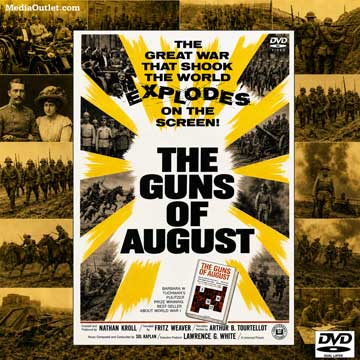
August 7, 1914: The European Civil War:
World War I: The First European War (The European Theater Of World
War I): The Guns Of August: The Western Front Of World War I: The
Battle Of The Frontiers: The Battle Of Mulhouse (The Battle Of
Alsace): -- The opening attack of the First World War occurs when
the French Army mobilizes against the German Empire to begin the
Battle Of Mulhouse, part of a French attempt to recover the
province of Alsace. By the early morning of August 9, parts of the
XIV and XV Corps of the German 7th Army arrived from Strasbourg
and counter-attacked at Cernay, 17 km northwest of Mulhouse on the
Thur River, which the French Forces succeeded in occupying on
August 8. The French were forced out of Mulhouse by the German 7th
Army counter-attacks on August 10, 1914. The Battle Of Mulhouse
was part of a French attempt to recover the province of Alsace,
which France had ceded to the new German Empire following defeat
in the Franco-Prussian War of 1870-1871. On Sale Until Midnight
Tonight PT!
https://store.earthstation1.com/the-guns-of-august-dvd-1964-world-war-i-movie-documen1964.html
Today's
EarthStation1.com 15% (Or More!) Off Commemorative Memorial Title:
CBS European War News: The Summer Of 1940 MP3 Set CD, Download,
USB
Today, August 7, 2026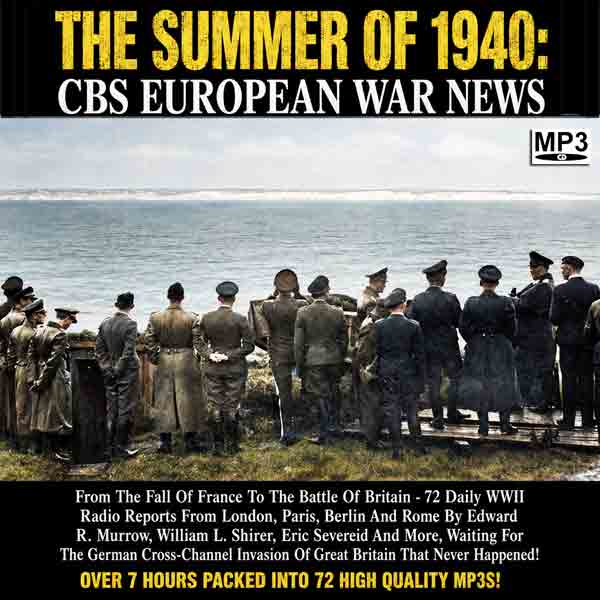
August 7, 1940: The European Civil War:
World War II: The Second European War (The European Theater Of
World War II): The Eastern Front Of World War II: The Great
Patriotic War (The German-Soviet War): Operation Barbarossa: The
"Aufbau Ost" (German: "Buildup In The East")
Directive: -- The mobilisation of forces before the start of
Operation Barbarossa and the subsequent invasion of the Soviet
Union which would occur ten months later is set into motion when
Adolf Hitler issues the "Aufbau Ost" (German: Buildup In
The East) Directive, ordering Walter Warlimont, Deputy Chief of
Alfred Jodl, to determine the positions of Soviet troops in the
East. The appropriate directive was signed the next day by Wilhelm
Keitel. It stated that due to the threat of British air attack on
Eastern Germany it was necessary to use the eastern territories
for drawing and preparing the new units. In compliance with the
directive, the building organization of Fritz Todt started
equipping the battleground while the rear organs managed the
logistical support in the East. Meanwhile, preparations for
adjusting the Soviet rail gauge to match the Western European were
taking place. On Sale Until Midnight Tonight PT!
https://store.earthstation1.com/cbs-european-war-news-radio-mp3-cd-summer-of-1940-broad31940.html
Today's
EarthStation1.com 15% (Or More!) Off Commemorative Memorial Title:
France: Conquest To Liberation In World War II MP4 Video Download
DVD
Today, August 7, 2026
August 7, 1940: World War II: The
European Civil War: World War II: The Second European War (The
European Theater Of World War II): The Battle Of France (The
Western Campaign [German: Westfeldzug], The French Campaign
[German: Frankreichfeldzug; French: Campagne De France], The Fall
Of France): The Secret Annexation Of Alsace-Lorraine: --
Alsace-Lorraine is annexed by the Third Reich when Adolf Hitler
drafts an annexation law in 1940 that he kept secret, expecting to
announce it in the event of a German victory. Through a series of
laws which individually seemed minor, Berlin took de facto control
of Alsace-Lorraine, and Alsatians-Lorrainians were made subject to
be drafted into the German Army. During the occupation, Moselle
was integrated into a Reichsgau named Westmark and Alsace, a
territory which was amalgamated with Baden, a historical territory
which in earlier times was considered to be on both sides of the
Upper Rhine, but that after the Napoleonic Wars was considered
only east of the Rhine. Beginning in 1942, people from Alsace and
Moselle were made German citizens by decree of the Nazi
government. Beginning in October 1942, young Alsatian and
Lorrainian men were inducted into the German armed forces.
Sometimes they were known as the Malgre-Nous, which could be
translated into English as "against our will". A small
minority volunteered, notably the author of The Forgotten Soldier,
known by the pseudonym Guy Sajer. Ultimately 100,000 Alsatians and
30,000 Mosellans were enrolled, many of them to fight against the
Soviet Red Army, on Germany's Eastern Front. Most of those who
survived the war were interned in Tambov in Russia in 1945. Many
others fought in Normandy against the Allies as the malgre-nous of
the 2nd SS Panzer Division Das Reich, some of whom were involved
in the Oradour sur Glane and Tulle war crimes. Speaking French was
prohibited under German occupation, and learning standard German
was obligatory. The Imperial Territory of Alsace-Lorraine was a
territory created by the German Empire in 1871, after it annexed
most of Alsace and the Moselle department of Lorraine following
its victory in the Franco-Prussian War. The Alsatian part lay in
the Rhine Valley on the west bank of the Rhine River and east of
the Vosges Mountains. The Lorraine section was in the upper
Moselle valley to the north of the Vosges. The territory was made
up of 93% of Alsace and 26% of Lorraine; the remaining portions of
these regions continued to be part of France. For historical
reasons, specific legal dispositions are still applied in the
territory in the form of a "local law". The territory
reverted back to France after World War II, and since then, in
relation to its special legal status, the territory has been
referred to administratively as Alsace-Moselle. After the defeat
of France in the spring of 1940 during World War II, Alsace and
Moselle were not formally annexed by Nazi Germany; however,
although the terms of the armistice specified that the integrity
of the whole French territory could not be modified in any way,
Adolf Hitler drafted an annexation law in 1940 that he kept
secret, expecting to announce it in the event of a German victory.
Through a series of laws which individually seemed minor, Berlin
took full control of Alsace-Lorraine, and Alsatians-Lorrainians
could be drafted into the German Army. During the occupation,
Moselle was integrated into a Reichsgau named Westmark and Alsace
was amalgamated with Baden. Beginning in 1942, people from Alsace
and Moselle were made German citizens by decree of the Nazi
government. On Sale Until Midnight Tonight PT!
https://store.earthstation1.com/france-conquest-to-liberation-occupied-and-vichy-wwii.html
Today's
EarthStation1.com 15% (Or More!) Off Commemorative Memorial Title:
The Nobel Century Nobel Prize History TV Series DVD, MP4, USB
Stick
Today, August 7, 2026
August 7, 1904: #BOTD: #HBD! Ralph
Bunche, African American political scientist, academic, and
diplomat, 1950 Nobel Peace Prize laureate for his late 1940s
mediation on behalf of the United Nations that helped bring an end
to hostilities in the war between Israel and the Arab League, the
first African American to be honored with a Nobel Prize (d.
December 9, 1971) is #born Ralph Johnson Bunche in Detroit,
Michigan. Ralph J. Bunche was involved in the formation and
administration of the United Nations. In 1963, he was awarded the
Presidential Medal Of Freedom by President John F. Kennedy. Ralph
Bunche died in New York City from complications of heart disease,
kidney disease, and diabetes, aged 67. He is buried in Woodlawn
Cemetery in the Bronx. On Sale Until Midnight Tonight PT!
https://store.earthstation1.com/the-nobel-century-nobel-prize-history-tv-series-dvd-mp4-us4.html
Today's
EarthStation1.com 15% (Or More!) Off Commemorative Memorial Title:
Eyes On The Prize II: America At The Racial Crossroads DVD MP4 USB
Today, August 7, 2026
August 7, 1960: Civil Rights Movements:
The American Civil Rights Movement (1954-1968): Civil Rights
Organizations (Civil Rights Movement Organizations): African
American Civil Rights Organizations (Civil Rights Movement
Organizations): The Student Non-Violent Coordinating Committee
(SNCC): Kneel-Ins: -- On a Sunday, twenty-five black and white
students of The Student Non-Violent Coordinating Committee (SNCC)
begin staging "kneel-ins" -- kneeling in prayer outside
of Whites-only churches -- at Presbyterian Atlanta churches, as
way to "dramatize that the church, the house of all people,
fosters segregation more than any other institution". Only
two churches allowed the students to join their congregation on
that day; the following Sunday. August 14, five churches accepted
the students. The students were from New York University,
Morehouse College, Spellman College, Howard University, and Fisk
University. The churches, targeted because their "ministers
lacked the protection and support of a church hierarchy,"
were not long indifferent. In August 1960, the 172nd General
Assembly of the United Presbyterian Church wrote to SNCC: "Laws
and customs requiring racial discrimination are, in our judgement,
such serious violations of the law of God as to justify peaceful
and orderly disobedience or disregard of these laws." On Sale
Until Midnight Tonight PT!
https://store.earthstation1.com/eyes-on-the-prize-ii-dvd-set-4-discs-complete-2nd-seri42.html
Today's
EarthStation1.com 15% (Or More!) Off Commemorative Memorial Title:
DJ Madness! 1950s-60s-70s Radio Shows DVD, MP3 Download, USB Drive
Today, August 7, 2026
August 7, 1928: #BOTD: #HBD: Herb Reed,
African American singer and both founding and naming member of The
Platters, known for timeless hits such as Only You (and You Alone)
and The Great Pretender (d. June 4, 2012) is #born Herbert Reed
into poverty in Kansas City, Missouri. Reed was the last surviving
original member of the group, which he co-founded with Joe
Jefferson, Alex Hodge, and Cornell Gunter (who later founded The
Coasters) in 1952. Reed is credited with creating The Platters'
name; Reed thought of the group's name after noticing that DJs in
the 1950s called their records "platters". The Platters
are one of the most successful vocal groups of the early rock and
roll era. The group had 40 charting singles on the Billboard Hot
100 chart between 1955 and 1967, including four number-one hits.
Originally, their distinctive sound was a bridge between the
pre-rock Tin Pan Alley tradition and the burgeoning new genre. The
act went through several personnel changes, with one of the most
successful incarnations comprising lead tenor Tony Williams, David
Lynch, Paul Robi, Herb Reed, and Zola Taylor, the same line-up of
The Platters that appeared in the first rock'n'roll film, Rock
Around the Clock. He was the only member of The Platters who sang
on all of the approximately 400 songs recorded by the group. His
background vocals can be heard on The Platters' biggest hits,
including "Smoke Gets in Your Eyes", "The Great
Pretender", "Twilight Time", and "My Prayer".
He is the lead vocalist on "Sixteen Tons", "Singin'
in the Rain", "In a Little Spanish Town", "Sleepy
Time Gal", "Darktown Strutters' Ball", "Blues
in the Night", and "On the Top of My Mind". As the
last surviving original member of The Platters, Reed waged a long
but successful federal court battle over the rights to the name,
The Platters. The courts ruled that Reed was the only heir to the
group's name. In 2012, Reed said in an interview, "It's not
right to have someone steal your name. It's just not right. We
were cheated back then, but that's how things were done...It's
theft, and I have to fight it so that no other artist faces this."
He moved to the Boston area during the 1970s after the success of
The Platters. Reed toured throughout his career. He performed as
many as 200 concerts per year until 2012, when he stopped due to
declining health. He died from complications from several
ailments, including heart disease, at a hospice in Boston on June
4, 2012, aged 83. He had most recently resided in Winchester,
Massachusetts. He is buried in Puritan Lawn Memorial Park in
Peabody, Massachusetts. In 1990, Reed was elected to the Rock and
Roll Hall of Fame as a member of The Platters. On Sale Until
Midnight Tonight PT!
https://store.earthstation1.com/dj-radio-airchecks-mp3-dvd-1950s60s70s-dis319506070.html
Today's
EarthStation1.com 15% (Or More!) Off Commemorative Memorial Title:
The History Of Jazz A Video Retrospective DVD, MP4 Download, USB
Drive
Today, August 7, 2026
August 7, 1935: #BOTD: #HBD! Rahsaan
Roland Kirk, known earlier in his career simply as Roland Kirk,
African American jazz multi-instrumentalist who played tenor
saxophone, flute, and many other instruments, renowned for his
onstage vitality, during which virtuoso improvisation was
accompanied by comic banter, political ranting, and the ability to
play several instruments simultaneously, one of whoses best-known
recorded performances is the lead flute and solo on Jones' "Soul
Bossa Nova", a 1964 hit song repopularized in the Austin
Powers films, and whose "Serenade To A Cuckoo" inspired
leader and flautist of Jethro Tull Ian Anderson to make flute
playing the signature element of the band and thereby found
coincidentally the musical genre "Flute Rock" (d.
December 5, 1977) is #born Ronald Theodore Kirk in Columbus, Ohio,
where he lived in a neighborhood known as Flytown. He became blind
at two years old, which he said was a result of improper medical
treatment. As a teenager, Kirk studied at the Ohio State School
for the Blind. By 15, he was on the road playing rhythm and blues
on weekends with Boyd Moore's band. According to saxophonist Hank
Crawford, "He would be like this 14-year-old blind kid
playing two horns at once. They would bring him out and he would
tear the joint up." Crawford heard him during this period and
said he was unbelievable. He remarked, "Now they had him
doing all kinds of goofy stuff but he was playing the two horns
and he was playing the shit out of them. He was an original from
the beginning." Kirk felt compelled by a dream to transpose
two letters in his first name to make '"Roland". In
1970, Kirk added "Rahsaan" to his name after hearing it
in a dream. Kirk was politically outspoken. During his concerts,
between songs he often talked about topical issues, including
African-American history and the Civil Rights Movement. His
monologues were often laced with satire and absurdist humor.
According to comedian Jay Leno, when Leno toured with Kirk as
Kirk's opening act, Kirk would introduce him by saying: "I
want to introduce a young brother who knows the black experience
and knows all about the white devils.... Please welcome Jay Leno!"
Kirk's hometown of Columbus was not appreciative of his work for
most of his career. He was thrown out of a local nightclub because
his music was too difficult to understand, and he left for Los
Angeles and further touring. In the 21st century, jazz fans in
Columbus have been embracing his legacy. Kirk's musical career
spans from 1955 until his death in 1977. He preferred to lead his
own bands and rarely performed as a sideman, although he did
record with arranger Quincy Jones, drummer Roy Haynes and worked
with bassist Charles Mingus. Kirk's multi-instrumentality was
credited as having a substantial musical conception. This
inclusivity included blues music, a love of stride piano and early
jazz, and an appreciation for pop tunes. But his vision was much
wider than that of most of his contemporaries. According to
producer Joel Dorn, he was also hugely knowledgeable about
classical music. Pieces by Saint-Saens, Hindemith, Tchaikovsky,
Dvorak and Villa-Lobos would all feature on his albums over the
years, alongside standards, pop songs and original compositions.
Rahsaan's influences went beyond jazz and consequentially, he
preferred the term "Black Classical Music". His playing
was generally rooted in soul jazz or hard bop, but Kirk's
knowledge of jazz history allowed him to draw from many elements
of the music's past, from ragtime to swing and free jazz. Kirk
also absorbed classical influences, and his artistry reflected
elements of pop music by composers such as Smokey Robinson and
Burt Bacharach, as well as Duke Ellington, John Coltrane and other
jazz musicians. Kirk played and collected many musical
instruments, mainly multiple saxophones, clarinets and flutes. His
primary saxophones were a standard tenor saxophone, stritch (a
straight alto sax lacking the instrument's conventional upturned
bell), and a manzello (a modified saxello soprano sax, with a
larger, upturned bell). A number of his instruments were exotic or
homemade. Kirk modified instruments himself to accommodate his
simultaneous playing technique. Critic Gary Giddins wrote that
Kirk's tenor playing alone was enough to bring him "renown".
Usually, he appeared on stage with all three horns hanging around
his neck, and at times he would play a number of these horns at
once, harmonizing with himself, or sustain a note for lengthy
durations by using circular breathing. He used the multiple horns
to play true chords, essentially functioning as a one-man
saxophone section. Kirk insisted that he was only trying to
emulate the sounds he heard in his head. Even while playing two or
three saxophones at once, the music was intricate, powerful jazz
with a strong feel for the blues. The live album Bright Moments
(1973) is an example of one of his shows. Kirk was also an
influential flute player, including recorders. According to
Giddins, Kirk was the first major jazz innovator on flute after
Eric Dolphy (who died in 1964). Kirk employed several techniques,
including singing or humming into the flute at the same time as
playing. Another was to play the standard transverse flute at the
same time as a nose flute. He played a variety of other
instruments, including whistles; often kept a gong within reach;
the clarinet, harmonica, English horn, and was a competent
trumpeter. He utilized unique approaches, such as playing a
trumpet with a saxophone mouthpiece. He also made use of
non-musical devices, such as alarm clocks, sirens, or a section of
common garden hose (dubbed "the black mystery pipes").
From the early 1970s, his studio recordings used tape-manipulated
musique concrete and primitive electronic sounds before such
things became commonplace. The Case of the 3 Sided Dream in Audio
Color was a unique album in the annals of recorded jazz and
popular music. It was a two-LP set, with Side 4 apparently
"blank", the label not indicating any content. However,
once word of "the secret message" got around among
Rahsaan's fans, one would find that about 12 minutes into Side 4
appeared the first of two telephone answering machine messages
recorded by Kirk, the second following soon thereafter (but
separated by more blank grooves). The surprise impact of these
segments appearing on "blank" Side 4 was lost on the
initial CD reissue of this album (though restored as track 20 on
the CD re-release). He gleaned information on what was happening
in the world via radio and TV. His later recordings often
incorporated his spoken commentaries on current events, including
Richard Nixon's involvement in the Watergate scandal. The 3-Sided
Dream album was a "concept album" which incorporated
"found" or environmental sounds and tape loops, tapes
being played backwards, etc. Snippets of Billie Holiday singing
are also heard briefly. The album even confronts the rise of
influence of computers in society, as Rahsaan threatens to pull
the plug on the machine trying to tell him what to do. In the
album Other Folks' Music the spoken words of Paul Robeson, another
outspoken black artist, can be briefly heard. His legacy and
influence are immense; Ian Anderson, leader and flautist of Jethro
Tull recorded a version of Kirk's "Serenade to a Cuckoo"
on their first album This Was (1968). Roland Kirk was the very
reason Anderson thought he could bring a flute into rock music.
Anderson learned Kirk's vocalizing style on the flute and
Anderson's flute playing became the signature element of Jethro
Tull's sound. Kirk and Anderson took the flute's refined upper
crust classical nature and commonized it. Anderson got to know
Kirk at the 1969 Newport Jazz Festival where they both performed
the same night. Anderson said of Kirk "There's something
about these colourful shamans. They can tease us, but we go along
with it, because we know they're touched by genius, but at the
same time there's a little bit of the snake oil for sale.".
Jeff Coffin, the saxophonist in Bela Fleck and the Flecktones was
heavily influenced by Kirk's music and says he learned through
Kirk that it's OK to experiment with an instrument. He used Kirk's
multi-horn inventions with the Flecktones and on his solo album
Mutopia. Guitarist Jimi Hendrix "idolized" Kirk, and
even hoped to collaborate with him one day. Frank Zappa had been
influenced by Kirk's music to a considerable extent early in his
career. In the liner notes to his 1966 debut album with The
Mothers of Invention, Freak Out!, Zappa cites Kirk as one of many
in a lengthy list of personal musical influences. Kirk and Zappa
performed live together at least once, at the 1969 Boston Globe
Jazz Festival. Derek Trucks, a huge Kirk fan, recorded Kirk's
composition "Volunteered Slavery" with his namesake
group for the 2004 album Live at Georgia Theatre, the 2006 studio
album Songlines, and the DVD Songlines Live. He said that hearing
Kirk's music "felt much the same way those Hendrix records
felt, that he was blowing the rules wide open..." David
Jackson, of Van der Graaf Generator, was also highly influenced by
the style and technique of Kirk, and he plays multiple saxophones
simultaneously since at least 1969. Guitarist Michael Angelo Batio
said in a 2008 interview with Ultimate Guitar Archive that Kirk's
playing of two saxophones at once inspired him to create his
"double guitar". T.J. Kirk was a band named after the
three artists it tributed: Thelonious Monk, James Brown, and
Rahsaan Roland Kirk. Formed by eight-string guitarist Charlie
Hunter as a side group to his own self-titled band, the band's
other members include Scott Amendola, Will Bernard, and John
Schott. Paul Weller cited the Kirk album I Talk with the Spirits
(1964) as one of his "Most Influential Albums" in an
interview with The Times in 2009. Bjork named The Inflated Tear as
one of her favorite jazz pieces, calling it "primitive and
instinctive", "open to nature", and "punk".
Davey Payne's twin saxophone solo on "Hit Me with Your Rhythm
Stick" (Ian Dury & the Blockheads, 1978) was inspired by
Kirk. Terry Edwards' twin saxophone solo on "The Ministry of
Defence" by PJ Harvey (2016) was inspired by Kirk. Eric
Burdon and War's 1970 debut album Eric Burdon Declares War
features the track "The Vision of Rassan", which is
broken up into two pieces "Dedication" and "Roll on
Kirk". The English post-punk group Rip Rig + Panic were named
after the album of the same name by Roland Kirk. Clutch pay
tribute to Roland Kirk in the song "Three Golden Horns"
off their 2022 album Sunrise on Slaughter Beach. Jazz producer
berlioz pays homage to Roland Kirk in the track "ode to
rahsaan" from berlioz's 2024 album open this wall. In 1975,
Kirk had a major stroke which led to partial paralysis of one side
of his body. He continued to perform and record, modifying his
instruments to enable him to play with one arm. At a live
performance at Ronnie Scott's Jazz Club in London he even managed
to play two instruments, and carried on to tour internationally
and to appear on television. He died from a second stroke in 1977,
aged 42, the morning after performing in the Frangipani Room of
the Indiana University Student Union in Bloomington, Indiana. He
is buried at Evergreen Burial Park in Columbus. Columbus Mayor
Jack Sensenbrenner had declared Saturday, Dec. 10, 1970, "Rahsaan
day," according to the Columbus Dispatch obituary that
appeared on Thursday, Dec. 8, 1977. On Sale Until Midnight Tonight
PT!
https://store.earthstation1.com/the-history-of-jazz-by-billy-taylor-parts-i-amp-ii-dvd.html
Today's
EarthStation1.com 15% (Or More!) Off Commemorative Memorial Title:
The Great Polynesian Navigators Of The Pacific DVD, MP4, USB Drive
Today, August 7, 2026
August 7, 1947: Great Sailing
Expeditions: Experimental Archaeology: Pre-Columbian Trans-Oceanic
Contact: The Kon-Tiki Expedition: -- Norwegian explorer and writer
Thor Heyerdahl's balsa wood raft, the Kon-Tiki, smashes into the
reef at Raroia in the Tuamotu Islands and makes a safe and
successful landfall after a 101-day, 7,000 kilometres (4,300 mi)
journey across the Pacific Ocean with five companions in an
attempt to prove that pre-historic peoples could have traveled
from South America. The raft was named Kon-Tiki after the Inca god
Viracocha (Quechuan language: Wiraqucha, possibly meaning "Fat
(or foam) of the sea"), for whom "Kon-Tiki" was
said to be an old name. Kon-Tiki is also the name of Heyerdahl's
book, the Academy Award-winning 1950 documentary film chronicling
his adventures, and the 2012 dramatized feature film nominated for
the Academy Award for Best Foreign Language Film. Heyerdahl
believed that people from South America could have reached
Polynesia during pre-Columbian times. His aim in mounting the
Kon-Tiki expedition was to show, by using only the materials and
technologies available to those people at the time, that there
were no technical reasons to prevent them from having done so.
Although the expedition carried some modern equipment, such as a
radio, watches, charts, sextant, and metal knives, Heyerdahl
argued they were incidental to the purpose of proving that the
raft itself could make the journey. The Kon-Tiki expedition was
funded by private loans, along with donations of equipment from
the United States Army. Heyerdahl and a small team went to Peru,
where, with the help of dockyard facilities provided by the
Peruvian authorities, they constructed the raft out of balsa logs
and other native materials in an indigenous style as recorded in
illustrations by Spanish conquistadores. Thor Heyerdahl's book
about his experience became a bestseller. It was published in
Norwegian in 1948 as The Kon-Tiki Expedition: By Raft Across the
South Seas, later reprinted as Kon-Tiki: Across the Pacific in a
Raft. It appeared with great success in English in 1950, also in
many other languages. A documentary motion picture about the
expedition, also called Kon-Tiki, was produced from a write-up and
expansion of the crew's filmstrip notes and won an Academy Award
in 1951. It was directed by Heyerdahl and edited by Olle Nordemar.
The voyage was also chronicled in the documentary TV-series The
Kon-Tiki Man: The Life and Adventures of Thor Heyerdahl, directed
by Bengt Jonson. There have been multiple hypotheses on the
ultimate origin and mode of dispersal of the Austronesian peoples.
One of the most widely accepted theories is that modern
Austronesians originated from migrations out of Taiwan between
3000 and 1000 BC. Using relatively advanced maritime innovations
like the catamaran, outrigger boats, and crab claw sails, they
were reputed to have rapidly colonized the islands of both the
Indian and the Pacific oceans, and were considered the first
humans to cross vast distances of water on ocean-going boats.
While Polynesians are known to have definitely originated from a
branch of the Austronesian migrations in Island Melanesia, despite
the popularity of hypotheses like Thor Heyerdahl's that
Polynesians were descendants of "bearded white men" who
sailed on primitive rafts from South America, a genetic study by
Stanford University published in the journal Nature on July 8,
2020 concluded that about 800 years ago, Polynesians from the
South Pacific and Native Americans from what is now Colombia
hooked up, creating a genetic signature that still exists in some
Polynesians today. A 2014 study of 27 modern people from Rapa Nui
(Easter Island) found they had Native American ancestry dating
back to between 1300 C.E. and 1500 C.E., at least 200 years before
the first Europeans landed there in 1722 C.E. Other pieces of
evidence have suggested there was pre-Columbian contact between
people in Polynesia and South America. Previous genetic studies of
sweet potatoes suggest the plant was domesticated in Peru and then
spread across Polynesia around 1,000 years ago. And the Polynesian
name for the root vegetable, "kuumala", resembles its
names in the Andean Quechua language: "kumara" and
"cumal." While the genetic record substantiates a common
ancestry, it is nonetheless most likely that it was the
long-established seafaring culture of the Polynesians that
initiated the contact between them and Native Americans - which
means that though Thor Heyerdahl was right that a vessel could
cross the Pacific between South America and Polynesia, contact
would most likely have been made from Polynesia to South America,
and not as Heyerdahl thought the other way round. The original
Kon-Tiki raft is now on display in the Kon-Tiki Museum at Bygdoy
in Oslo. On Sale Until Midnight Tonight PT!
https://store.earthstation1.com/the-great-polynesian-navigators-of-the-pacific-dvd-mp3-us3.html
Today's
EarthStation1.com 15% (Or More!) Off Commemorative Memorial Title:
TV Commercials: The Mego Toy Classics DVD, MP4 Download, USB Drive
Today, August 7, 2026
August 7, 1927: #BOTD: #HBD! Carl
Switzer, American child actor, comic singer, dog breeder, hunting
guide and (possibly) freemason, best known for his role as Alfalfa
in the Our Gang series of short-subject comedies, one of the
series' most popular and best-remembered characters (d. January
21, 1959) is #born Carl Dean Switzer (rhyming with "Schweitzer")
in Paris, Illinois. He began his career as a child actor in 1934,
when the Switzers traveled to California to visit family. While
sightseeing, they went to Hal Roach Studios. Following a public
tour, eight-year-old Harold and six-year-old Carl entered the Hal
Roach Studio's open-to-the-public cafeteria, the Our Gang Cafe,
and began an impromptu performance. Producer Hal Roach was present
and was impressed. He signed both brothers to appear in Our Gang.
Harold was given two nicknames, "Slim" and "Deadpan",
while Carl was dubbed "Alfalfa". The brothers first
appeared in the 1935 Our Gang short Beginner's Luck. By the end of
the year, Alfalfa was one of the main characters, with a
distinctive cowlick hairstyle, while Harold had been relegated to
the background. Although Carl was an experienced singer and
musician, his character Alfalfa was often called upon to sing
popular songs for comic effect, most often those of Bing Crosby
and Pinky Tomlin. The comic effect was achieved by playing the
musical accompaniment slightly beyond the young singer's range, so
Switzer would struggle to reach the high notes -- resulting in
squeaky, off-key tones. By the end of 1937, Switzer's "Alfalfa"
had surpassed the series' nominal star, George "Spanky"
McFarland, in popularity. While the boys got along, their fathers
argued constantly over their sons' screen time and salaries.
Switzer's best friend among the Our Gang actors was Tommy Bond,
who played his on-screen nemesis "Butch". In Bond's
words, he and Switzer became good friends because "neither of
us could replace the others". After outgrowing the Our Gang
series in 1940, Switzer struggled to find substantial roles, but
was typecast as a juvenile actor. As an adult, he appeared mainly
in bit parts and B-movies. Switzer married grain elevator empire
heiress Diantha Collingwood in 1954 and they had one son; they
divorced in 1957. In 1987, former Our Gang co-star George "Spanky"
McFarland recalled a meeting with Switzer when they spoke about
the farm: "The last time I saw Carl was 1957. It was a tough
time for me - and him. I was starting a tour of theme parks and
county fairs in the Midwest. Carl had married this girl whose
father owned a pretty good-size farm near Wichita. When I came
through town, he heard about it and called. He told me he was
helping to run the farm, but he finally had to put a radio on the
tractor while he was out there plowing. Knowing Carl, I knew that
wasn't going to last. He may have come from Paris, Illinois, but
he wasn't a farmer! We hadn't seen each other since we left the
'Gang.' So we had lunch. We talked about all the things you'd
expect. And then I never saw him again. He looked pretty much the
same. He was just Carl Switzer - kind of cocky, a little antsy -
and I thought to myself he hadn't changed that much. He still
talked big. He just grew up." On January 26, 1958, Switzer
was getting into his car in front of a bar in Studio City, when a
bullet smashed through the window and struck him in the upper
right arm. However, the gunman was never caught. Later that
December, Switzer was arrested in Sequoia National Forest for
cutting down 15 pine trees he had intended to sell illegally as
Christmas trees. He was sentenced to one year's probation. Switzer
was also ordered to pay a 225 USD fine (more than 2,400 USD
today). Carl Switzer died aged 31 under mysterious circumstances;
most likely, he was murdered by a fatal pistol shot to the groin
by a disgruntled customer of Switzer's dog training business. He
is buried at Hollywood Forever Cemetery in Los Angeles,
California. Sometime in 1959, Switzer agreed to train a hunting
dog, a Treeing Walker Coonhound, for Moses Samuel "Bud"
Stiltz. Stiltz was Switzer's longtime friend and sometime business
partner, whom Switzer had met while working with Roy Rogers on
various productions at the Corriganville Movie Ranch. The dog,
while in Switzer's possession, ran off to chase after a bear and
disappeared. After learning that the dog had been lost while in
Switzer's care, Stiltz demanded that Switzer had to either return
his dog or pay him the equivalent of the dog's value. Switzer was
then working as a bartender. Unable to produce the money to settle
the debt, Switzer took out ads in newspapers and put up fliers,
offering a reward for the safe return of the animal. Eventually,
the dog was located and brought to the bar where Switzer was
working. Switzer rewarded the rescuer with 35 US and 15 USD in
drinks (equivalent to 520 USD in 2023). Switzer was annoyed by the
cash outlay; a few days later, in an emotional conversation with
his friend Jack Piott, a 37-year-old unit still photographer, the
two decided that Stiltz should reimburse Switzer the finder's fee.
Their argument was that the dog was Stiltz's and not Switzer's.
The two arrived at Stiltz's home in Mission Hills, at 10400
Columbus Avenue. Stiltz shared the home with his wife, Rita
Corrigan, and his stepchildren. Switzer and Piott intended to
demand money from Stiltz. From here on, accounts of what happened
differ. All agree that Stiltz was struck over the left side of his
head with a glass clock. He later retreated to his room to
retrieve a .38-caliber revolver, and Switzer tried to wrest the
gun from him. Their struggle caused the gun to discharge and
almost shot Tom Corrigan, Stiltz's 14-year-old stepson. Stiltz
regained the weapon and shot Switzer. According to Stiltz, the
event was one of self-defense, testifying that Switzer had banged
on his front door, yelling "Let me in, or I'll kick in the
door." The threat was followed by a struggle that began with
one of the men, Switzer or Piott, striking Stiltz with the clock.
This prompted Stiltz to retrieve his firearm. According to Stiltz,
Switzer threatened him with a knife and yelled, "I'm going to
kill you!" Stiltz fired and shot Switzer in the groin,
damaging an artery that caused massive internal bleeding. Switzer
was pronounced dead on arrival at 7:27 pm at the hospital at the
age of 31. Tom Corrigan's account, however, differed significantly
from his stepfather's. He told investigators that Stiltz shot
Switzer as he and Piott were leaving. After the gun's accidental
discharge that almost hit Corrigan, Switzer turned to Piott and
said they needed to leave. The two were headed for the door when
Stiltz then fired the fatal shot. Switzer never drew a knife, as
Stiltz had claimed he had. Corrigan was never called to testify at
the coroner's inquest, and Stiltz testified in his own favor. His
testimony was taken to be truthful, despite physical evidence that
contradicted his account and his past perjury conviction. Years
later, Corrigan stood by what he told officers had happened that
night, and said his stepfather did not have to kill Switzer. In an
apparent miscarriage of justice, the shooting was judged to be
self-defense.; during the inquest regarding Switzer's death, it
was revealed that what was reported as a "hunting knife"
was in fact a penknife. It had been found by crime scene
investigators under his body. Over 42 years later, in January
2001, Tom Corrigan told reporters "It was more like murder".
He said he heard the knock on the front door, and Switzer said
"Western Union for Bud Stiltz." Corrigan's mother, Rita
Corrigan, opened the door to find a drunk Switzer, complaining
about a perceived month-old debt and demanding repayment. Corrigan
said Switzer entered the house first, followed by Jack Piott.
Switzer said he was going to beat up Stiltz, and Stiltz confronted
Switzer with a .38-caliber revolver in his hand. Corrigan said
that Switzer grabbed the revolver and Stiltz and Switzer struggled
over it. He said Piott broke a glass-domed clock over Stiltz's
head, causing Stiltz's eye to swell shut. During the struggle, a
shot was fired into the ceiling and Corrigan was struck in the leg
by a fragment. Corrigan said his two younger sisters ran to a
neighbor's house to call for help. "Well, we shot Tommy,
enough of this," he said he recalled Switzer saying, just
before Switzer and Piott started to leave the house. Corrigan said
he had just stepped out the front door when he heard, but did not
witness, a second shot behind him. He said he then turned and saw
Switzer sliding down the wall with a surprised look on his face
after Stiltz had shot him. Corrigan said he saw a closed penknife
at Switzer's side, which he presumed fell out of his pocket or his
hand. He said he then saw his stepfather shove Piott against the
kitchen counter and threaten to kill him too. Corrigan said they
heard emergency sirens as Piott begged for his life, and that he
thought this was the only reason Stiltz did not kill Piott.
Corrigan said his stepfather lied in his account of the event
before the coroner's jury. Corrigan said a Los Angeles Police
Department detective interviewed him and asked if he would testify
before the judge. Corrigan said he agreed to, but he was never
called before the court. Moses Stiltz died in 1983 at the age of
62. On Sale Until Midnight Tonight PT!
https://store.earthstation1.com/tv-commercials-the-mego-toy-classics-dvd.html
Today's
EarthStation1.com 15% (Or More!) Off Commemorative Memorial Title:
Universal Newsreels: The Space Race Films DVD MP4 Download USB
Drive
Today, August 7, 2026
August 7, 1959: Rocket Launches: The
History Of Rocketry: The History Of Spaceflight: The Aftermath Of
World War II: The Cold War: The Space Age: The Space Race: The
United States Space Program: Earth Satellites: Explorer 6 (S-2):
-- Explorer 6, which took the first pictures of Earth from space,
is launched atop a Thor DM-18 Able III rocket at 14:24:20 GMT from
the Atlantic Missile Range in Cape Canaveral, Florida. Explorer 6,
or S-2, was a small, spheroidal satellite designed to study
trapped radiation of various energies, galactic cosmic rays,
geomagnetism, radio propagation in the upper atmosphere, and the
flux of micrometeorites. It also tested a scanning device designed
for photographing the Earth's cloud cover, and transmitted the
first pictures of Earth via satellite. The satellite was launched
into a highly elliptical orbit with an initial local time of
apogee of 2100 h. The satellite was spin-stabilized at 2.8 rps,
with the direction of the spin axis having a right ascension of
217 degrees and a declination of 23 degrees. Four solar cell
paddles mounted near its equator recharged the storage batteries
while in orbit. Each experiment except the television scanner had
two outputs, digital and analog. A UHF transmitter was used for
the digital telemetry and the TV signal. Two VHF transmitters were
used to transmit the analog signal. The VHF transmitters were
operated continuously. The UHF transmitter was operated for only a
few hours each day. Only three of the solar cell paddles fully
erected, and this occurred during spin up rather than prior to
spin up as planned. Consequently, initial operation of the payload
power supply was 63% nominal, and this decreased with time. The
decreased power caused a lower signal-to-noise ratio affecting
most of the data, especially near apogee. One VHF transmitter
failed on September 11, 1959, and the last contact with the
payload was made on October 6, 1959, at which time the solar cell
charging current had fallen below that required to maintain the
satellite equipment. In 1959 an anti-satellite missile test of the
Bold Orion rocket used Explorer 6 as a target. The missile
successfully passed within 6.4 kilometers (4.0 mi) of the
satellite. Bold Orion's ASAT mission occurred on Tuesday, 13
October 1959. Launch took place within the Atlantic Missile Range
Drop Zone (AMR DZ). The altitude, latitude and longitude of the
drop point were 11,000 m (35,000 ft), 29_ North and 79_ West,
respectively. Bold Orion successfully intercepted the Explorer 6
satellite, passing its target at a range of less than 6.5 km (3.5
nmi) and an altitude of 252 km (136 nmi). The satellite's orbit
decayed on July 1, 1961. A total of 827 hours of analog and 23
hours of digital data were obtained. On Sale Until Midnight
Tonight PT!
https://store.earthstation1.com/universal-newsreels-the-space-race-films-dvd-mp4-download-usb-driv4.html
Today's
EarthStation1.com 15% (Or More!) Off Commemorative Memorial Title:
Outer Space Films 9: Mars Probes DVD, Video Download, USB Flash
Drive
Today, August 7, 2026
August 7, 1976: The History Of Rocketry:
The History Of Spaceflight: The Aftermath Of World War II: The
Cold War: The Space Age: The Space Race: The Discovery And
Exploration Of The Solar System: Space Probes: Interplanetary
Space Probes: The United States Space Program: Spacecraft Missions
To Mars: The Viking Program: Viking 2: -- The Viking 2 planetary
probe, famous for taking "Face On Mars" photos, enters
orbit around Mars. Viking 2 was a single package of two separate
parts, an orbiter and a lander, essentially identical to that of
the successful Viking 1 mission. Viking 2 was launched at 18:39
UTC on September 9, 1975 atop a Titan IIIE launch vehicle with a
Centaur upper stage from Cape Canaveral Space Launch Complex 41
(LC-41), now known as Space Launch Complex 41 (SLC-41), which
almost unique among legacy launch sites continues to operate as an
active launch site at Cape Canaveral Space Force Station. The
Viking 2 lander operated on the surface for 1316 days (3 years,
221 days), or 1281 sols (Martian days), and was turned off on
April 11, 1980 when its batteries failed. The Viking 2 orbiter
worked until July 25, 1978, returning almost 16,000 images in 706
orbits around Mars. Its photos of the Cydonia region of Mars, as
well as those taken by Viking 1, contains the controversial "Face
on Mars", located about halfway between Arandas Crater and
Bamberg Crater. On Sale Until Midnight Tonight PT!
https://store.earthstation1.com/outer-space-films-9-mars-space-probe-projects-viking-amp-mariner-dv9.html
Today's
EarthStation1.com 15% (Or More!) Off Commemorative Memorial Title:
We Remember: The Space Shuttle Pioneers 1981-1986 DVD, Download,
USB
Today, August 7, 2026
August 7, 1985: Outer Space Firsts: The
History Of Rocketry: The History Of Spaceflight: The Aftermath Of
World War II: The Cold War: The Space Age: The Space Race: Space
Programs Of The United States: Human Spaceflight Programs: The
Space Shuttle Program (The Space Transportation System (STS)): The
National Space Development Agency Of Japan (NASDA) (Japanese: Uchu
Kaihatsu Jigyodan): Japanese Astronauts: -- Misters Takao Doi and
Mamoru Mohri, and Mrs. Chiaki Mukai, are chosen to be Japan's
first astronauts as part of NASA's Space Shuttle Program. Takao
Doi, the first Japanese astronaut to conduct a spacewalk, servied
on Columbia STS-87 (1997-11-19 - 1997-12-05) and Endeavour STS-123
(2008-03-11 - 2008-03-25); Mamoru Mohri, the first Japanese in
space, served on Endeavour STS-47, (1992-09-12 - 1992-09-20) and
Endeavour STS-99 (2000-02-11 - 2000-02-22); and Chiaki Mukai, the
first Japanese woman in space, served on Columbia STS-65
(1994-07-08 - 1994) and Discovery STS-95 (1998-10-29 -
1998-11-07). All three were selected by The National Space
Development Agency Of Japan (Japanese: Uchu Kaihatsu Jigyodan), or
NASDA, a Japanese national space agency established on October 1,
1969 under the National Space Development Agency Law only for
peaceful purposes. Based on the Space Development Program enacted
by the Minister of Education, Culture, Sports, Science and
Technology (MEXT), NASDA was responsible for developing
Japanese-built satellites and launch vehicles as well as launching
and tracking them. The first launch vehicles of NASDA (N-I, N-II,
and H-I) were partially based on licensed technology from the
United States, particularly the Delta rocket family. The H-II was
the first liquid fuel rocket to be fully developed in Japan. Hideo
Shima, chief engineer of the original Shinkansen "bullet
train" project, served as Chief of NASDA from 1969 to 1977.
On October 1, 2003, NASDA merged with the Institute of Space and
Astronautical Science (ISAS) and the National Aerospace Laboratory
of Japan (NAL) into one Independent Administrative Institution:
the Japan Aerospace Exploration Agency (JAXA). SL-J was partially
funded by Japan through NASDA; this cooperative Japanese-American
mission launched a NASDA astronaut into Earth orbit using the
Space Shuttle in 1992. Work on the Japanese Experiment Module at
ISS, and also HOPE-X, was started under NASDA and inherited by
JAXA. On Sale Until Midnight Tonight PT!
https://store.earthstation1.com/we-remember-the-space-shuttle-pioneers-198119811986.html
Today's
EarthStation1.com 15% (Or More!) Off Commemorative Memorial Title:
War Jets: The Lockheed SR-71 Blackbird DVD, Video Download, USB
Drive
Today, August 7, 2026
August 7, 1963: Aviation: The History Of
Aviation: The History Of Military Aviation: Maiden Flights: -- The
Lockheed YF-12 Mach 3+ capable high-altitude interceptor prototype
takes its maiden flight Developed and manufactured by American
aerospace company Lockheed Corporation during the late 1950s and
early 1960s as a potential replacement for the F-106 Delta Dart
interceptor for the United States Air Force (USAF), the YF-12 was
a twin-seat version of the then-secret single-seat Lockheed A-12
reconnaissance aircraft operated by the Central Intelligence
Agency (CIA); unlike the A-12, it was furnished with the Hughes
AN/ASG-18 fire-control radar and could be armed with AIM-47 Falcon
(GAR-9) air-to-air missiles. Its existence was publicly revealed
by President Lyndon B. Johnson on February 24, 1964; this move was
to provide plausible deniability for the CIA-operated A-12 fleet,
which closely resembled the prototype YF-12. During the 1960s,
after 3 YF-12s were built, the underwent flight evaluations by the
USAF, but funding to put it into operational use was not
forthcoming partly due to the pressing demands of the Vietnam War
and other military priorities. It set and held speed and altitude
world records of over 2,000 miles per hour (3,200 km/h) and over
80,000 feet (24,000 m) (later surpassed by the closely related
SR-71 Blackbird), and is the world's largest, heaviest and fastest
crewed interceptor. Following its retirement by the USAF, it
served as a research aircraft for NASA for a time, which used it
to develop several significant improvements in control for future
supersonic aircraft. On Sale Until Midnight Tonight PT!
https://store.earthstation1.com/war-jets-the-lockheed-sr71-blackbird-d71.html
Today's
EarthStation1.com 15% (Or More!) Off Commemorative Memorial Title:
Fraulein Doktor 1969 Suzy Kendall Kenneth More Nigel Green DVD MP4
USB
Today, August 7, 2026
August 7, 1887: #BOTD: #HBD! Elsbeth
Schragmuller, also known as Fraulein Doktor and Mademoiselle
Docteur (Mlle. Docteur), as well as Fair Lady, La Baronne and
Mlle. Schwartz (Mademoiselle Schwartz), German spy, lieutenant and
Iron Cross First Class recipient (d. February 24, 1940, Munich,
Germany) is #born in Schlusselburg near Petershagen, Kingdom of
Prussia, German Empire. Elsbeth Schragmuller was a German spy
during World War I whose identiity was unknown until her actual
name was revealed only in 1945, gleaned from German intelligence
documents captured by the Allies after World War II, when she had
already died of miliary tuberculosis in 1940. Her nickname
acknowledges the fact that she had a doctoral degree in political
science, not psychology as some fictional portrayals have claimed,
from the University of Freiburg. She was one of the first
generation of German women to gain an academic degree.
Schragmuller was the eldest of four children born to Prussian Army
officer and bailiff Carl Anton Schragmuller and his wife Valesca
Cramer von Clausbruch. Her younger brother was the future
Sturmabteilung (SA) police chief of Magdeburg, Konrad
Schragmuller. Schragmuller spent her childhood first in
Schlusselburg and then in Munster with her grandmother, who
educated her. From 1909 to 1914, she studied political science at
Albert-Ludwigs-Universitat in Freiburg. She finished her studies
in 1913 and was one of the first women in Germany to acquire a
university degree. After her studies, she worked for the Berlin
Lette-Verein as a lecturer in civic education. After the outbreak
of the First World War, Schragmuller moved to occupied Belgium,
where the German governor general, Colmar von der Goltz, assigned
her to Section VII, where she opened and intercepted letters. She
later switched to intelligence collection and worked, after a
short training period, in Lille for the General Staff's
intelligence wing, the Abteilung IIIb. In 1915, Colonel Walter
Nicolai, the head of Abteilung IIIb, assigned her as the chief of
the Kriegsnachrichtenstelle Antwerpen. When the war ended,
Schragmuller held the rank of lieutenant and had been awarded the
Iron Cross First Class. After the armistice in 1918, Schragmuller
resumed her academic career and became the first female assistant
chair at Freiburg University. A few years later, she moved with
her family to Munich. Soon afterward, her father and her brother
Konrad, a senior SA officer, were shot during the Night of the
Long Knives. Soon, she ended her career abruptly for unknown
reasons. Schragmuller died in 1940 at the age of 52 of bone
tuberculosis in her Munich apartment. Her burial details are not
publicly disclosed. Her activities were the subject of various
urban legends during the First World War, but since she was
neither captured nor unmasked during her lifetime, much of her
life story remains obscure and speculative, and it is unclear to
what extent the various fictional treatments of her life story are
accurate. Her death early in the Second World War makes it
unlikely that she contributed materially to the war effort even if
some have claimed that she again engaged in espionage activities.
On Sale Until Midnight Tonight PT!
https://store.earthstation1.com/fraulein-doktor-1969-dvd-world-war-i-spy-thri1969.html
Today's
EarthStation1.com 15% (Or More!) Off Commemorative Memorial Title:
World War I: The War Years Documentary Series DVD, Download, USB
Drive
Today, August 7, 2026
August 7, 1876: #BOTD: #HBD! Mata Hari,
Dutch exotic dancer, courtesan, harlot and international spy who
was arrested and executed by the French in 1917 for spying for
Germany during World War I (d. October 15, 1917) is #born
Margaretha Geertruida Zelle in Leewarden, Netherlands. Known as
"Margreet" by her friends, Margaretha Geertruida MacLeod
famously declared her innocence during her trial with the words "A
harlot? Yes, but a traitor, never!" The idea of a beautiful
exotic dancer using her powers of seduction as a spy made her name
synonymous with the femme fatale. Her story has served as an
inspiration for many books, films, and other works. It has been
said that she was convicted and condemned because the French Army
needed a scapegoat, and that the files used to secure her
conviction contained several falsifications. Some have even stated
that Mata Hari could not have been a spy and was innocent. She was
convicted of being a German spy and sentenced to death. At her
execution, she refused a blindfold and instead threw a kiss to the
French firing squad. Mata Hari's body was not claimed by any
family members and was accordingly used for medical study. Her
head was embalmed and kept in the Museum of Anatomy in Paris. In
2000, archivists discovered that it had disappeared, possibly as
early as 1954, according to curator Roger Saban, during the
museum's relocation. Her head remains missing. Records dated 1918
show that the museum also received the rest of the body, but none
of the remains could later be accounted for. Mata Hari's sealed
trial and other related documents, a total of 1,275 pages, were
declassified by the French Army in 2017, one hundred years after
her execution. On Sale Until Midnight Tonight PT!
https://store.earthstation1.com/world-war-i-the-war-years-dvd-4-part-french-tv-serie4.html
Today's
EarthStation1.com #OnThisDay Commemorative Memorial Title: Outer
Space Films 3 Project Apollo Reaching For The Moon DVD, MP4, USB
Today, August 7, 2026 August 7, 2025: #DOTD: #RIP: Jim Lovell,
distinguished American astronaut, naval aviator, test pilot, and
mechanical engineer, command module pilot of Apollo 8 in which he,
Frank Borman and William Anders became the first astronauts to fly
to and orbit the Moon, commander of the Apollo 13 lunar mission
which, after a critical failure en route, looped around the Moon
and returned safely to Earth (b. March 25, 1928) #dies at his home
in Lake Forest, Illinois at the age of 97. Lovell's wife, Marilyn
had died of natural causes on August 27, 2023, at the age of 93;
they are buried beside each other in the United States Naval
Academy Cemetery in Annapolis, Maryland. Jim Lovell was born James
Arthur Lovell Jr. in Cleveland, Ohio. A 1952 graduate of the
United States Naval Academy in Annapolis, Maryland, Lovell flew
McDonnell F2H Banshee night fighters. He was deployed in the
Western Pacific aboard the aircraft carrier USS Shangri-La. In
January 1958, he entered a six-month test pilot training course at
the Naval Air Test Center at Naval Air Station Patuxent River,
Maryland, with Class 20 and graduated at the top of the class. He
was then assigned to Electronics Test, working with radar, and in
1960 he became the Navy's McDonnell Douglas F-4 Phantom II program
manager. In 1961, he became a flight instructor and safety
engineering officer at Naval Air Station Oceana in Virginia Beach,
Virginia, and completed Aviation Safety School at the University
of Southern California. Lovell was not selected by NASA as one of
the Mercury Seven astronauts due to a temporarily high bilirubin
count. He was accepted in September 1962 as one of the second
group of astronauts needed for the Gemini and Apollo programs.
Before Apollo, Lovell flew in space on two Gemini missions: Gemini
7 (with Borman) in 1965 and Gemini 12 in 1966. He was the first
person to fly into space four times. Among the 24 astronauts who
have orbited the Moon, Lovell was the earliest to make a second
visit but remains the only returnee never to walk on the surface.
He was a recipient of the Congressional Space Medal of Honor and
the Presidential Medal of Freedom. He cowrote the 1994 book Lost
Moon, on which the 1995 film Apollo 13 was based, and he was
featured in a cameo appearance in the film.
https://store.earthstation1.com/outer-space-films-3-project-apollo-reaching-for-the-moon-dv3.html
August 7, 2025: #DOTD: #RIP: Jim Lovell,
distinguished American astronaut, naval aviator, test pilot, and
mechanical engineer, command module pilot of Apollo 8 in which he,
Frank Borman and William Anders became the first astronauts to fly
to and orbit the Moon, commander of the Apollo 13 lunar mission
which, after a critical failure en route, looped around the Moon
and returned safely to Earth (b. March 25, 1928) #dies at his home
in Lake Forest, Illinois at the age of 97. Lovell's wife, Marilyn
had died of natural causes on August 27, 2023, at the age of 93;
they are buried beside each other in the United States Naval
Academy Cemetery in Annapolis, Maryland. Jim Lovell was born James
Arthur Lovell Jr. in Cleveland, Ohio. A 1952 graduate of the
United States Naval Academy in Annapolis, Maryland, Lovell flew
McDonnell F2H Banshee night fighters. He was deployed in the
Western Pacific aboard the aircraft carrier USS Shangri-La. In
January 1958, he entered a six-month test pilot training course at
the Naval Air Test Center at Naval Air Station Patuxent River,
Maryland, with Class 20 and graduated at the top of the class. He
was then assigned to Electronics Test, working with radar, and in
1960 he became the Navy's McDonnell Douglas F-4 Phantom II program
manager. In 1961, he became a flight instructor and safety
engineering officer at Naval Air Station Oceana in Virginia Beach,
Virginia, and completed Aviation Safety School at the University
of Southern California. Lovell was not selected by NASA as one of
the Mercury Seven astronauts due to a temporarily high bilirubin
count. He was accepted in September 1962 as one of the second
group of astronauts needed for the Gemini and Apollo programs.
Before Apollo, Lovell flew in space on two Gemini missions: Gemini
7 (with Borman) in 1965 and Gemini 12 in 1966. He was the first
person to fly into space four times. Among the 24 astronauts who
have orbited the Moon, Lovell was the earliest to make a second
visit but remains the only returnee never to walk on the surface.
He was a recipient of the Congressional Space Medal of Honor and
the Presidential Medal of Freedom. He cowrote the 1994 book Lost
Moon, on which the 1995 film Apollo 13 was based, and he was
featured in a cameo appearance in the film.
https://store.earthstation1.com/outer-space-films-3-project-apollo-reaching-for-the-moon-dv3.html
Today's
EarthStation1.com #OnThisDay Commemorative Memorial Title: Outer
Space Mission MP3 MegaSet DVD, Audio Download, USB Flash Drive
Today, August 7, 2026August 7, 1971: Splashdowns: The History
Of Rocketry: The History Of Spaceflight: The Aftermath Of World
War II: The Cold War: The Space Age: The Space Race: Space
Programs Of The United States: Human Spaceflight Programs: The
Discovery And Exploration Of The Solar System: Missions To The
Moon: Project Apollo: Apollo 15 (AS-15): -- Apollo 15 splashes
down in the North Pacific at 20:45:53 UTC and is recovered by the
USS Okinawa (LPH-3). Apollo 15 was launched July 26, 1971,
13:34:00.6 UTC from Kennedy Space Center with Astronauts David
Scott, James Irwin and Alfred Worden aboard. Apollo 15 was the
ninth manned mission in the United States' Apollo program, the
fourth to land on the Moon, and the eighth successful manned
mission. It was the first of what were termed "J missions"
(longer three-day stays using an Extended Lunar Module weighing
2,900 pounds heaver than the initial LM model, with three LEVAs
and a Lunar Roving Vehicle (Apollo 15, Apollo 16, Apollo 17)),
with a greater focus on science than had been possible on previous
missions. It was also the first mission on which the Lunar Roving
Vehicle, or Lunar Rover, was used. A recording of the launch was
included in the Sounds of Earth carried by the Voyager 1 and
Voyager 2 space probes. The mission began on July 26, 1971, and
ended on August 7. At the time, NASA called it the most successful
manned flight ever achieved. Commander David Scott and Lunar
Module Pilot James Irwin landed on the Moon on July 30, 1971 and
spent three days there, including 18 1/2 hours outside the
spacecraft on lunar extra-vehicular activity (EVA). The mission
landed near Hadley Rille, in an area of the Mare Imbrium called
Palus Putredinus (Marsh of Decay). The crew explored the area
using the first lunar rover, which allowed them to travel much
farther from the Lunar Module (LM) than had been possible on
missions without the rover. They collected 77 kilograms (170 lb)
of lunar surface material. At the same time, Command Module Pilot
Alfred Worden orbited the Moon, using a Scientific Instrument
Module (SIM) in the Service Module (SM) to study the lunar surface
and environment in great detail with a panoramic camera, a
gamma-ray spectrometer, a mapping camera, a laser altimeter, a
mass spectrometer, and a lunar subsatellite deployed at the end of
Apollo 15's stay in lunar orbit (an Apollo program first). The
mission successfully accomplished its objectives, but was marred
by negative publicity that accompanied disclosure of the crew
carrying unauthorized postage stamps which they had planned to
sell after their return. Ironically, this mission was one of very
few that had been honored with the issue of a commemorative US
stamp, with this first use of a lunar rover happening one decade
after the first Mercury astronaut launch.
https://store.earthstation1.com/outer-space-mission-mp3-dvd-megaset-4-dis34.html
Today's
EarthStation1.com #OnThisDay Commemorative Memorial Title: Hell On
Earth: The Kuwaiti Oil Fires Documentary Set MP4 Download DVD
Today, August 7, 2026August 7, 2004: #DOTD: #RIP: Red Adair,
American oil well firefighter, notable as an innovator in the
highly specialized and hazardous profession of extinguishing and
capping oil well blowouts, both land-based and offshore (b. (June
18, 1915) #dies in Houston, the city of his birth, at the age of
89. He is buried in a crypt at Forest Park Lawndale in Houston. He
was survived by his wife, a son and a daughter. Paul Neal "Red"
Adair was born the son of an Irish blacksmith, and attended Reagan
High School. He began fighting oil well fires after returning from
serving in an Army bomb disposal unit during World War II. He
started his career working for Myron Kinley, the "original"
blowout/oil firefighting pioneer. They pioneered the technique of
using a V-shaped charge of high explosives (the Munroe effect
being used during the war and used in bazookas and the atom bomb),
the high velocity blast of which would snuff the fire. He founded
Red Adair Co. Inc. in 1959, and over the course of his career
battled more than 2,000 land and offshore oil well, natural gas
well, and similar spectacular fires. Adair gained global attention
in 1962 when he tackled a fire at the Gassi Touil gas field in the
Algerian Sahara nicknamed the Devil's Cigarette Lighter, a
450-foot (140 m) pillar of flame that burned from 12:00 PM
November 13, 1961, to 9:30 AM on April 28, 1962. The 1968 John
Wayne movie Hellfighters was loosely based upon the feats of Adair
during this fire. In December 1968, Adair sealed a large gas leak
at an Australian gas and oil platform off Victoria's southeast
coast. In 1977, he and his crew (including Asger "Boots"
Hansen and Manohar "Man" Dhumtara-Kejriwal) contributed
to the capping of the biggest oil well blowout to have occurred in
the North Sea (and at the time the largest offshore blowouts
worldwide, in terms of volume of crude oil spilled, at the Ekofisk
Bravo platform, located in the Norwegian sector and operated by
Phillips Petroleum Company (now ConocoPhillips). In 1978, Adair's
top lieutenants Hansen and Ed "Coots" Matthews left to
found competitor Boots & Coots International Well Control Inc.
In 1988, Adair was again in the North Sea where he helped to put
out the UK sector Piper Alpha oil platform fire. At age 75, Adair
took part in extinguishing the oil well fires in Kuwait set by
retreating Iraqi troops after the Gulf War in 1991. Adair retired
in 1993, and sold The Red Adair Service and Marine Company to
Global Industries. His top employees (Brian Krause, Raymond Henry,
Rich Hatteberg) left in 1994 and formed their own company,
International Well Control (IWC).
https://store.earthstation1.com/hell-on-earth-the-kuwaiti-oil-fires-dvd-mp4-download-usb-flash-driv4.html
Today's
EarthStation1.com #OnThisDay Commemorative Memorial Title: The
Johnstown Flood Documentary DVD, Video Download, USB Flash Drive
Today, August 7, 2026August 7, 2022: #DOTD: #RIP: David
McCullough, American popular historian and author (b. July 7,
1933) #dies at his home in Hingham, Massachusetts, aged 89 of
undisclosed causes after a period of failing health. His burial
details are not publicly disclosed. David McCullough was born
David Gaub McCullough in the Point Breeze neighborhood of
Pittsburgh, Pennsylvania, where he was raised. He is a two-time
winner of the Pulitzer Prize and the National Book Award and a
recipient of the Presidential Medal Of Freedom, the United States'
highest civilian award. McCullough earned a degree in English
literature from Yale University. His first book was The Johnstown
Flood (1968), and he wrote nine more on such topics as Harry S.
Truman, John Adams, Theodore Roosevelt, the Brooklyn Bridge, the
Panama Canal, and the Wright brothers. McCullough also narrated
numerous documentaries, such as The Civil War by Ken Burns, as
well as the 2003 film Seabiscuit, and he hosted the PBS television
documentary series American Experience for twelve years.
McCullough's two Pulitzer Prize-winning books - Truman and John
Adams - were adapted by HBO into a TV film and a miniseries,
respectively.
https://store.earthstation1.com/the-johnstown-flood-the-great-flood-of-1889-in-johnstown-pennsylv1889.html
Today's
EarthStation1.com #OnThisDay Commemorative Memorial Title: Laurel
And Hardy Documentaries Collection DVD, Download, USB Drive
Today, August 7, 2026August 7, 1957: #DOTD: #RIP: Oliver
Hardy, American comedian, actor, singer, film director, one half
of Laurel and Hardy, the double act that began in the era of
silent films and lasted 25 years, from 1927 to 1951, and Freemason
(b. January 18, 1892) #dies from cerebral thrombosis (a blood clot
in the brain) at his home in North Hollywood, Los Angeles at age
65. After he was cremated, his ashes were interred in the Masonic
Garden of Valhalla Memorial Park Cemetery in North Hollywood.
Laurel was inconsolable at the loss of his "dear pal and
partner"; his doctor advised Laurel against attending the
funeral, due to his own poor health, and Laurel said that "Babe
would understand." He was born Oliver Norvell Hardy in
Harlem, Georgia to Oliver Hardy Sr., a Confederate veteran who had
been wounded at the Battle Of Antietam and was a recruiting
officer for Company K, 16th Georgia Regiment, and Emily Norvell,
descended from Captain Hugh Norvell, who served in King William's
War and helped found and govern Williamsburg, Virginia. Known
informally as "Babe", Hardy appeared with his comedy
partner Stan Laurel in 107 short films, feature films, and cameo
roles. He was credited with his first film, Outwitting Dad, in
1914. In most of his silent films before joining producer Hal
Roach, he was billed on screen as Babe Hardy. Hardy was initiated
into Freemasonry at Solomon Lodge No. 20 in Jacksonville, Florida.
He was inducted into the Grand Order Of Water Rats, a
quasi-Masonic organization with Masonic roots, along with Stan
Laurel, which in large part inspired their movie Sons Of The
Desert and the appreciation society for Oliver and Hardy films
that sprang from that movie.
https://store.earthstation1.com/laurel-and-hardy-documentaries-dvd.html
Today's
EarthStation1.com #OnThisDay Commemorative Memorial Title: Black
Civil Rights Films: African-American History DVD, MP4, USB Stick
Today, August 7, 2026August 7, 1950: #BOTD: Alan Keyes,
African American conservative politician, diplomat, 16th Assistant
Secretary Of State for International Organization Affairs from
1985 to 1987, and jerk, is #born at the St. Albans Naval Hospital
(now a VA Community Living Center) in St. Albans, Queens, New York
City. A member of the Republican Party, Keyes sought the
nomination for President of the United States in 1996, 2000, and
2008. A doctoral graduate of Harvard University, Keyes began his
diplomatic career in the U.S. Foreign Service in 1979 at the
United States consulate in Bombay, India, and later in the
American embassy in Zimbabwe. Keyes was appointed Ambassador to
the Economic and Social Council of the United Nations by President
Ronald Reagan and later as President Reagan's Assistant Secretary
of State for International Organization Affairs, a position he
held from November 13, 1985, until November 17, 1987; in his
capacities as a U.N ambassador, Keyes was involved in the
implementation of the Mexico City Policy. Aside from his
presidential runs, he was the Republican nominee for the U.S.
Senate in Maryland against Paul Sarbanes in 1988 and Barbara
Mikulski in 1992, as well as in Illinois against Barack Obama in
2004. Keyes lost all three elections by wide margins. Keyes hosted
a radio call-in show, The Alan Keyes Show: America's Wake-Up Call,
from 1994 until 1998 on WCBM. The show was briefly simulcast by
National Empowerment Television. In 2002, he briefly hosted a
television commentary show on the MSNBC cable network, Alan Keyes
Is Making Sense. He is a long time columnist for World Net Daily.
On November 14, 2008, Keyes filed a lawsuit - naming as defendants
California Secretary Of State Deborah Bowen, President-elect
Barack Obama, Vice President-elect Joe Biden, and California's 55
Democratic electors - challenging Obama's eligibility for the U.S.
Presidency. The suit requested that Obama provide documentation
that he is a natural born citizen of the United States. Following
the inauguration, Keyes alleged that President Obama had not been
constitutionally inaugurated, refused to call him president, and
called him a "usurper" and a "radical communist".
Keyes also claimed that President Obama's birth certificate had
been forged and he was not qualified to be president.
https://store.earthstation1.com/black-civil-rights-films-africanamerican-history-dvd.html
Today's
EarthStation1.com #OnThisDay Commemorative Memorial Title: An
Enemy Of The People (1990) DVD, MP4 Video Download, USB Flash
Drive
Today, August 7, 2026August 7, 1944: #BOTD: #HBD! John Glover,
American actor is #born John Soursby Glover Jr. in Kingston, New
York. He is known for a range of villainous roles in films and
television, including Daniel Clamp in Gremlins 2: The New Batch
and Lionel Luthor on the Superman-inspired television series
Smallville. He is also the voice of Riddler in the DC Animated
Universe. Raised in Salisbury, Maryland, Glover attended Wicomico
High School and acted at Towson University. His father was a
television salesman. Glover began his career at the Barter Theatre
in Abingdon, Virginia, and later studied acting at the Beverly
Hills Playhouse under Milton Katselas. Glover began his career in
television, playing a mentally disturbed kidnapper who kidnapped
Joanne, the lead character in Search for Tomorrow. One of his
early film performances was a role as a U.S. diplomat in White
Nights. His other roles include Alan Raimy in 52 Pick-Up, Bryce
Cummings in Scrooged, Tony Gateworth in Masquerade, Daniel Clamp
in Gremlins 2: The New Batch, a mobster in Payback, an advertising
spokesman in RoboCop 2, Derek Mills in Night of the Running Man,
the Riddler in Batman: The Animated Series, Doctor Jason Woodrue
in Batman & Robin, Verad in the Star Trek: Deep Space Nine
episode "Invasive Procedures", the Devil in the series
Brimstone, and a recurring role in The Days and Nights of Molly
Dodd as Cousin Jerry, from Bal'mer, a relative whom no one
actually seemed to know. In 1987, he appeared in the Miami Vice
episode "Lend Me an Ear" as Steve Duddy. He also
appeared in two episodes of Murder, She Wrote, "One White
Rose for Death" and "When Thieves Fall Out". He
appeared in the television film An Early Frost in 1985, the first
TV film to confront the issue of AIDS, and received an Emmy
nomination for his performance as a gay AIDS patient. In 1986, he
appeared in the TV film Apology with Lesley Ann Warren. He
appeared in the role of Max Brodsky, an inmate in concentration
camps and later a fighter for Israel's independence, in Ian
Sharp's 1989 TV miniseries Twist of Fate (also known as Pursuit).
That same year, he played a hard-driving, low-on-morals district
sales manager in HBO's Traveling Man. He also received a 1994 Emmy
nomination for Outstanding Guest Actor in a Comedy Series for his
appearance in Frasier. Glover is perhaps best known for his role
as Lionel Luthor on Smallville from 2001 to 2008 where he first
appeared as a guest actor in the show's first season and then
appeared as a full cast member from seasons two to seven. He later
returned in 2010 and 2011 for the tenth and final season as a
parallel universe version of the character. He had a small
appearance in the Woody Allen film Annie Hall (1977) in a
flashback in which he tells the title character, "Touch my
heart. With your foot." He had a recurring role in Law &
Order: Criminal Intent as Declan Gage, an old friend and mentor to
Detective Robert Goren. On ABC's Brothers & Sisters he played
Henry (the boyfriend of Saul Holden) in 2009. In Heroes he had a
brief appearance as Samson Gray, the father of Sylar. He had made
notable appearances on stage, winning a Tony Award for Featured
Actor in a Play for his dual roles in the Broadway play Love!
Valour! Compassion!, which he reprised in the film version. In
2004, he performed with the Philadelphia Theatre Company staging
of Edward Albee's The Goat, or Who Is Sylvia? He also appeared as
"man in the chair/narrator" in The Drowsy Chaperone on
Broadway during the summer of 2007. He played the role of Lucky in
a Broadway production of Samuel Beckett's Waiting for Godot, for
which he earned a Tony Award nomination for Best Performance by a
Featured Actor in a Play. In 2014, he appeared as Leonato in the
Shakespeare in the Park production of Much Ado About Nothing. He
played Telemachus in Yuri Rasovsky's Peabody Award-winning radio
dramatization of The Odyssey of Homer and has played in several
radio plays of the LA Theatre Works. Glover is receiving
increasing recognition for narrating audiobooks. In 2011, he
performed the audiobook version of Ghost Story, the thirteenth
novel in Jim Butcher's The Dresden Files series. In
October/November 2011, he performed in David Bar Katz's drama The
Atmosphere of Memory at the Bank Street Theatre in New York City,
co-starring with Ellen Burstyn in a LAByrinth production. He
played the role of Uncle Ben in the 2012 Broadway production of
Arthur Miller's Death of a Salesman, directed by Mike Nichols. He
is seen rehearsing the role of John Kreese in behind-the-scenes
pre-production footage from The Karate Kid, indicating he may have
been considered for that role. In 2013, Glover starred in the
horror anthology Sanitarium. He also guest-starred in an episode
of Agent Carter. Glover has done various voice-over work for
several projects related to Tron: Legacy: the villain Abraxas in
Tron: Evolution, and Dyson in Tron: Uprising. In 2014, he
guest-starred on The Blacklist in the episode titled "Berlin".
Glover is gay. He married sculptor Adam Kurtzman in 2016, whom he
had been dating since 1993. According to Glover, he slept with
Freddie Mercury in the 1970s. Glover is involved with the
Alzheimer's Association. His father had Alzheimer's disease,
leading Glover to become more active in charity and activism
surrounding the disorder. Glover returns to Towson annually to
work with theater students. The theater department awards a
scholarship in his name.
https://store.earthstation1.com/an-enemy-of-the-people-dvd-ibsen-arthur-miller-john-glover.html
Today's
EarthStation1.com #OnThisDay Commemorative Memorial Title: America
Held Hostage: As It Happened The Iran Hostage Crisis MP4 DVD
Today, August 7, 2026August 7, 2005: #DOTD: #RIP: Peter
Jennings, Canadian-American journalist, news anchor, documentary
host, and author who served as the sole anchor of ABC World News
Tonight for 22 years from 1983 until his death (b. July 29, 1938)
#dies of lung cancer in his New York apartment at the age of 67.
His fourth wife Kayce Freed, two children, and sister were at his
side. Just after 11:30 pm EDT that evening, Charles Gibson broke
into local news in the eastern U.S. and regular programming on
ABC's western affiliates to announce Jennings's death. The
anchor's ABC colleagues, including Barbara Walters, Diane Sawyer,
and Ted Koppel, shared their thoughts on Jennings's death. The
next morning, Brokaw and Rather fondly remembered their former
rival on the morning news shows. "Peter, of the three of us,
was our prince," said Brokaw on Today. "He seemed so
timeless. He had such elan and style." Canada's television
networks led off their morning news shows with the news of
Jennings's death and had remembrances from their "big three"
anchors, Peter Mansbridge at the CBC, Lloyd Robertson at CTV, and
Kevin Newman (himself a former colleague of Jennings at ABC) at
Global. American President George W. Bush and Canadian Prime
Minister Paul Martin offered statements of condolence to the
press. On August 10, 2005, ABC aired a two-hour special, Peter
Jennings: Reporter, with archival clips of his reports and
interviews with colleagues and friends. The special drew more than
nine million viewers, and was the most watched television program
of the night. For the week of his death, World News Tonight placed
number one in the ratings race for the first time since June 2004.
Jennings's widow, Kayce Freed, and family held a private service
in New York. Jennings's body was cremated and his ashes split in
half. Half of his ashes remained in his home on Long Island and
the other half was placed in his summer home in the Gatineau
Hills, near Ottawa. The 57th Primetime Emmy Awards on September
18, 2005, included a tribute to Jennings by Brokaw and Rather. A
public memorial service for Jennings was held two days later at
Carnegie Hall. Notable journalists, political leaders, and other
friends of Jennings attended. Jennings left a 50M USD estate: half
went to Freed, and most of the rest to his son and daughter. Peter
Charles Archibald Ewart Jennings CM was born in Toronto, Ontario.
Despite dropping out of high school, he transormed transformed
himself into one of American television's most prominent
journalists. Jennings started his career early, hosting a Canadian
radio show at the age of nine. He began his professional career
with CJOH-TV in Ottawa during its early years, anchoring the local
newscasts and hosting a teen dance show, Saturday Date, on
Saturdays. In 1965, ABC News tapped him to anchor its flagship
evening news program. His inexperience was attacked by critics and
others in television news, making for a difficult first stint in
the anchor chair. Jennings became a foreign correspondent in 1968,
reporting from the Middle East. He returned as one of World News
Tonight's three anchors in 1978, and was promoted to the role of
sole anchor in 1983. Jennings was also known for his marathon
coverage of breaking news stories, staying on the air for 15 or
more hours straight to anchor the live broadcast of events such as
the outbreak of the Gulf War in 1991, the Millennium celebrations
in 2000, and the September 11 attacks in 2001. In addition to
anchoring, he was the host of many ABC News special reports and
moderated several American presidential debates. Jennings was
always fascinated with the United States and became a naturalized
United States citizen in 2003. Along with Tom Brokaw at NBC and
Dan Rather at CBS, Jennings formed part of the "Big Three"
news anchors who dominated American evening network news from the
early 1980s until his death in 2005, which closely followed the
retirements of Brokaw in 2004 and Rather in 2005.
https://store.earthstation1.com/america-held-hostage-as-it-happened-the-iran-hostage-crisis-mp4-dv4.html
Today's
EarthStation1.com #OnThisDay Commemorative Memorial Title: KTLA:
The First 35 Years: Los Angeles TV Station Channel 5 DVD MP4 USB
Today, August 7, 2026August 7, 2007: #DOTD: #RIP: Hal Fishman,
television news anchor, journalist andrecord-holding aviator,
local news anchor in the Los Angeles area, serving on-air with Los
Angeles-area television stations continuously from 1960 until his
death in 2007, the longest-running news anchor in the history of
American television before Dave Ward surpassed him in 2015, the
partial inspiration for "The Simpsons" cartoon
television anchorman Kent Brockman (b. August 25, 1931) #dies. Hal
Fishman's last broadcast was on July 30, 2007, eight days before
his death. On July 31, 2007, the night before Fishman became ill
and after his last broadcast, KTLA celebrated his 47 years in
television with a special gala at the Autry National Museum in Los
Angeles. The event was emceed by Morning Show anchor Michaela
Pereira and attended by such dignitaries as Los Angeles mayor
Antonio Villaraigosa and Los Angeles County sheriff Lee Baca.
During the gala, Fishman spoke to the audience about his time in
television. He appeared somewhat fatigued but little would be
known about his condition until the day after. Fishman died at
home, 18 days before he would have turned 76, following recent
treatment for a liver infection, which had detected cancer in his
liver and colon. That morning, the station interrupted its regular
news schedule and dedicated much of the Morning Show and Prime
News broadcasts to Fishman. The reporters on Prime News did not
break for commercials that evening. His remains were cremated, and
the ashes scattered over the skies of Los Angeles, California. Hal
Fishman was born Harold Fishman in Brooklyn, New York City.
Fishman received a bachelor's degree from Cornell University where
he worked at the campus radio station. He also received a master's
degree in political science from UCLA in 1956. Planning for a
career in academia, he served as an assistant professor of
political science at California State University, Los Angeles for
two years. Eventually, Los Angeles independent television station
KCOP approached Fishman to teach an on-air course, and later, the
station invited him to anchor his own segment. Fishman had been on
the air continuously since June 20, 1960, moving from KCOP to KTLA
in 1965. That year, he received significant exposure as a field
reporter for KTLA when he helped cover the Watts Riots live from
the Los Angeles Police Department command center. Fishman also
worked at KTTV and KHJ-TV (now KCAL-TV) during the early 1970s,
returning to KTLA on January 8, 1975, to anchor their evening new
broadcast NewsWatch, later renamed News at Ten. As a news anchor,
Fishman covered numerous events in Los Angeles and the world,
ranging from the assassination of presidential candidate Robert F.
Kennedy, to the Sylmar and Northridge earthquakes, to Pope John
Paul II's 1987 visit to southern California. He, along with KTLA,
was credited for being the first to air footage of the police
beating of Rodney King in 1991, an event that sparked riots a year
later when the officers were acquitted. In 2000, KTLA dedicated
its newsroom in Fishman's honor, commemorating his 40 years in
television and his years of service and commitment to the region.
Fishman won myriad awards, including the Associated Press
Television-Radio Association's first-ever Lifetime Achievement
Award. He received a "star" on the Hollywood "Walk
of Fame," at 1560 Vine Street and KTLA named its television
news studio after Fishman. He also authored two novels, Flight 902
Is Down (co-authored with aviation writer Barry J. Schiff) and The
Vatican Target. Fishman was also an accomplished pilot and set 13
records for speed and altitude. In 1969, he was awarded the Louis
Bleriot medal by the Federation Aeronautique Internationale.
https://store.earthstation1.com/ktla-the-first-35-years-tv-channel-5-la-355.html
Today's
EarthStation1.com #OnThisDay Commemorative Memorial Title: Allied
Codebreakers Of WWI & WWII DVD MP4 Video Download USB Drive
Today, August 7, 2026August 7, 1958: #DOTD: #RIP: Herbert
Yardley, American cryptologist, author and recipient of the
Distinguished Service Medal, founder and leader of the first
modern ryptographic organization who laid the framewok for modern
cryptological analysis (b. April 13, 1889) #dies in Washington,
D.C. aged 69, nearly a week after having a major stroke. He is
buried at Arlington National Cemetery, Grave 429-1 of Section 30.
He was born Herbert Osborn Yardley in Worthington, Indiana. He
founded and led of the cryptographic organization the Black
Chamber, also known as the Cipher Bureau, the United States' first
peacetime cryptanalytic organization, and a forerunner of the
National Security Agency. Under Yardley, the cryptanalysts of The
American Black Chamber broke Japanese diplomatic codes and were
able to furnish American negotiators with significant information
during the Washington Naval Conference of 1921-1922 which provided
the United States and United Kingdom to obtain an agreement
ensuring naval superiority over the Japanse. He also wrote The
American Black Chamber (1931) about his experiences there and
detailing much regarding the Chamber's effect on the Washington
Naval Conference agreement known as the Washington Naval Treaty,
inciting great enmity from both the United States and United
Kingdeom. He went on to assist the Kuomintang Chinese Nationalists
in breaking Japanese codes during the Second Sino-Japanese War.
Following this work in China, Yardley worked for the Canadian
government from June to December 1941, helping it set up a
cryptological section known as the Examination Unit for the
National Research Council of Canada. Yardley was reportedly let go
from this position due to pressure either from the Secretary of
War Henry L. Stimson or from the British.
https://store.earthstation1.com/allied-codebreakers-of-wwi-amp-wwii-dvd-mp4-video-download-usb-driv4.html
Today's
EarthStation1.com #OnThisDay Commemorative Memorial Title: John
Fitzgerald Kennedy (1964) TV Special DVD, Download, USB Drive
Today, August 7, 2026August 7, 1963: #BOTD: #HBD! Patrick
Bouvier Kennedy, the last child of United States President John F.
Kennedy and First Lady Jacqueline Bouvier Kennedy (d. August 9,
1963) is #born prematurely, and 39 hours and 12 minutes later at
4:04 a.m. despite a desperate medical effort to save him, putting
the First Family and nation into mourning. At the time of the
infant's death, the president was outside the room with the
hyperbaric chamber with his brother, U.S. Attorney General Robert
F. Kennedy. The first lady, then 34, remained at Otis Air Force
Base Hospital recovering from the caesarean section. She was told
of her son's death by Dr. Walsh (who would console her again after
her husband's assassination and was aboard Air Force One with her
as she returned from Dallas with the president's body.) She was
given a sedative and slept until the president flew from Boston.
Very little was said about the family's reaction. White House
Press Secretary Pierre Salinger stated of the first lady's
condition: "Given the circumstances, her condition is
satisfactory." The president, who had reportedly slept only
four hours since the birth, was photographed arriving at Otis Air
Force Base looking grave and appearing tired. A small funeral mass
was held on August 10, 1963 in the private chapel of Cardinal
Richard Cushing in Boston. The president's mother was in Paris and
was told not to return for the funeral, but the first lady's
sister Lee Radziwill had already flown in from Greece before the
baby died. Cushing, the Archbishop of Boston, performed the
funeral mass, as he would for John F. Kennedy, assassinated 104
days later. Siblings Caroline, then five years old, and John Jr.,
two and a half, did not attend. The child was initially buried at
Holyhood Cemetery in Brookline, Massachusetts, the president's
hometown. His body and that of his stillborn sister Arabella were
reinterred on December 5, 1963, alongside their father, at
Arlington National Cemetery and later moved to their permanent
graves in Section 45, Grid U-35. Patrick Bouvier Kennedy's short
lifespan led to innovations in treatment of premature infants,
which gave rise to the pediatric subspecialty neonatology, a
subspecialty of pediatrics that consists of the medical care of
newborn infants, especially the ill or premature newborn. It is a
hospital-based specialty and is usually practised in neonatal
intensive care units (NICUs). The principal patients of
neonatologists are newborn infants who are ill or require special
medical care due to prematurity, low birth weight, intrauterine
growth restriction, congenital malformations (birth defects),
sepsis, pulmonary hypoplasia, or birth asphyxia.
https://store.earthstation1.com/john-fitzgerald-kennedy-1964-documentary1964.html
Today's
EarthStation1.com #OnThisDay Commemorative Memorial Title: The
Golden Age Of Comedy 5 Album Set CD, MP3, USB Stick
Today, August 7, 2026August 7, 1928: #BOTD: #HBD! Betty
Walker, Jewish-American actress and comedian who performed
primarily during the 1950s and 1960s (d. July 26, 1982) is #born
Edith Seeman in Elizabeth, New Jersey to Latvian Jewish
immigrants. Her first major acting role was on the sitcom The
Goldbergs, where at 21 years of age she played Mrs. Kramer,
Molly's loud-mouthed, nosy neighbor. She acted in the original
cast of Paddy Chayefsky's play "Middle of the Night",
which first premiered in 1956, and she reprised her role as the
Widow for the film adaptation three years later. In addition to
performing in Paddy Chayefsky's plays "The Passion of Josef
D" and "Middle of the Night" with Edward G.
Robinson, she acted in a number of other television dramas, such
as Decoy, Playhouse 90, and The Doctors, and in Susan Slade's
"Ready When You Are, C.B.!" with Julie Harris and
Estelle Parsons. In movies she was seen in "Molly",
"Exodus" and the screen version of "Middle of the
Night". As a popular comedian of the 1950s and 1960s, Walker
was best known for her "telephone act" wherein she
delivered a monologue to her unseen friend "Ceil" at the
other end of the line. The humor of this act draws upon the Jewish
stereotypes of the "overbearing mother" which had gained
popularity originally in Jewish joke books after World War II.
While the "Jewish mother" trope gained popularity in
newer venues such as on television, in print, and on comedy
albums, it is notable that she was often personified in these
mediums through her "son's vision" of her. It is
notable, then, that Walker actively assumed these traits, which
gave her transgressive mimetic power over them. She also recorded
comedy record albums, including "Aunt Lena and Her Entire
Family" and "Hello Ceil". Walker made guest
appearances on The Tonight Show Starring Johnny Carson, The Merv
Griffin Show, The Mike Douglas Show and The Steve Allen Show,
where she often performed her monologue to "Ceil." Betty
Walker died at her Manhattan home aged 54, having been ill for
some time, suffering from a variety of ailments. Funeral services
were held on July 28 at Parkside Chapel, 79th Street and Columbus
Avenue. Her burial details are not publicly disclosed.
https://store.earthstation1.com/golden-age-of-comedy-narrated-by-george-burns-5-album-set-mp3-53.html
Today's
EarthStation1.com #OnThisDay Commemorative Memorial Title: TV
Commercials: The Classics Vol. 3 DVD, Video Download, USB Drive
Today, August 7, 2026August 7, 2021: #DOTD: #RIP: Jane
Withers, American actress of stage, theater, radio and television,
and children's radio show host, famous as Josephine The Plumber in
a series of television commercials for Comet cleanser from 1963 to
1974 (b. April 12, 1926) #dies in Burbank, California at the age
of 95. Her remains were cremated; the final disposition of her
ashes are not publicly disclosed. She was born in Atlanta,
Georgia. She became one of the most popular child stars in
Hollywood in the 1930s and early 1940s, with her films ranking in
the top ten list for box-office gross in 1937 and 1938. She began
her entertainment career at the age of three and, during the
Golden Age of Radio, hosted her own children's radio program in
her home city of Atlanta, Georgia. In 1932, she and her mother
moved to Hollywood, where she appeared as an extra in many films
until landing her breakthrough role as the spoiled, obnoxious Joy
Smythe opposite Shirley Temple's angelic orphan Shirley Blake in
the 1934 film Bright Eyes. She made 38 films before retiring at
age 21 in 1947. She returned to film and television as a character
actor in the 1950s. In the 1990s and early 2000s, she did voice
work for Disney animated films. She was interviewed in numerous
documentary retrospectives of the Golden Age of Hollywood. She was
also known for her philanthropy and her extensive doll collection.
https://store.earthstation1.com/tv-commercials-the-classics-vol-3-dv3.html
Today's
EarthStation1.com #OnThisDay Commemorative Memorial Title: Medium
Cool (1969) News Media & The 1968 DNC DVD, Download, USB Drive
Today, August 7, 2026August 7, 1938: #BOTD: #HBD! Verna Bloom,
American actress of stage and screen (d. January 9, 2019) is #born
#Verna Frances Bloom in Lynn, Massachusetts. She made her film
debut in Medium Cool, and then co-starred in Clint Eastwood's 1973
film, High Plains Drifter and in the 1974 made-for-TV movie Where
Have All The People Gone? with Peter Graves and Kathleen Quinlan.
Bloom also had roles in more than 30 films and television episodes
beginning the 1960s, including playing Mary, mother of Jesus, in
The Last Temptation of Christ in 1988 and Marion Wormer in Animal
House in 1978. On Broadway, Bloom portrayed Charlotte Corday in
The Persecution And Assassination Of Jean-Paul Marat As Performed
By The Inmates Of The Asylum Of Charenton Under The Direction Of
The Marquis De Sade (1967) and Blanche Morton in Brighton Beach
Memoirs (1983). Bloom attended the School of Fine Arts at Boston
University, graduating with a BFA in 1959. She also studied at the
HB Studio in New York City. Bloom married Richard Collier, but
they separated by 1969. They began the Trident Theater in Denver
Colorado, which operated from 1963 to 1965. In 1972 she married
film critic Jay Cocks. They had a son, Sam, born in 1981. The
couple remained married until her death. Bloom died aged 80 on
January 9, 2019, in Bar Harbor, Maine, from complications of
dementia. Her remains were cremated, and the ashes given to her
widow. https://store.earthstation1.com/medium-cool-dvd.html
Today's
EarthStation1.com #OnThisDay Commemorative Memorial Title: France:
Conquest To Liberation In World War II MP4 Video Download DVD
Today, August 7, 2026August 7, 2011: #DOTD: #RIP: Nancy Wake,
also known as Madame Fiocca and Nancy Fiocca, codenamed Helene
(SOE), Andree (French Resistance/SOE Identity) and White Mouse
(Gestapo in France), New Zealand-English nurse, journalist,
captain and spy who served in the French Resistance and later as
an agent of the British Special Operations Executive (SOE) during
World War II, post-war intelligence officer in the British Air
Ministry, a courier and leading figure in the maquis groups of the
French Resistance who later joined the escape network of Captain
Ian Garrow, the Gestapo's most wanted person in 1943 with a
5-million-franc price on her head, one of the Allies' most
decorated servicewomen (b. August 30, 1912) #dies aged 98 at
Kingston Hospital after being admitted with a chest infection. She
had requested that her ashes be scattered at Montlucon in central
France. Her ashes were scattered near the village of Verneix,
which is near Montlucon, on March 11, 2013. Her obituary was
included in (and inspired the title for) The Socialite Who Killed
A Nazi With Her Bare Hands: And 144 Other Fascinating People Who
Died This Year, a collection of New York Times obituaries
published in 2012. The official historian of the SOE, M.R.D. Foot,
said that "her irrepressible, infectious, high spirits were a
joy to everyone who worked with her." Nancy Grace Augusta
Wake, AC, GM was born in Roseneath, Wellington, New Zealand, the
youngest of six children. She was Maori through her
great-grandmother Pourewa, believed to be of the Ngati Mahanga
Iwi, who was reportedly one of the first Maori women to marry a
European. Wake was living in Marseille with her French
industrialist husband, Henri Fiocca, when the war broke out. After
the fall of France to Nazi Germany in 1940, Wake became a courier
for the Pat O'Leary escape network led by Ian Garrow and, later,
Albert Guerisse. As a member of the escape network, she helped
Allied airmen evade capture by the Germans and escape to neutral
Spain. In 1943, when the Germans became aware of her, she escaped
to Spain and continued on to the United Kingdom. Her husband was
captured and executed. After reaching Britain, Wake joined the
Special Operations Executive (SOE) under the code name "Helene".
On April 29-30, 1944 as a member of a three-person SOE team
code-named "Freelance", Wake parachuted into the Allier
department of occupied France to liaise between the SOE and
several Maquis groups in the Auvergne region, which were loosely
overseen by Emile Coulaudon (code name "Gaspard"). She
participated in a battle between the Maquis and a large German
force in June 1944. In the aftermath of the battle, she claimed to
have bicycled 500 kilometers to send a situation report to SOE in
London. Wake was a recipient of the George Medal from the United
Kingdom, the Medal Of Freedom from the United States, the Legion
of Honor from France, and medals from Australia and New Zealand.
In 1985, she published her autobiography, The White Mouse, the
title derived from what the Germans called her.
https://store.earthstation1.com/france-conquest-to-liberation-occupied-and-vichy-wwii.html